Heap
Heap

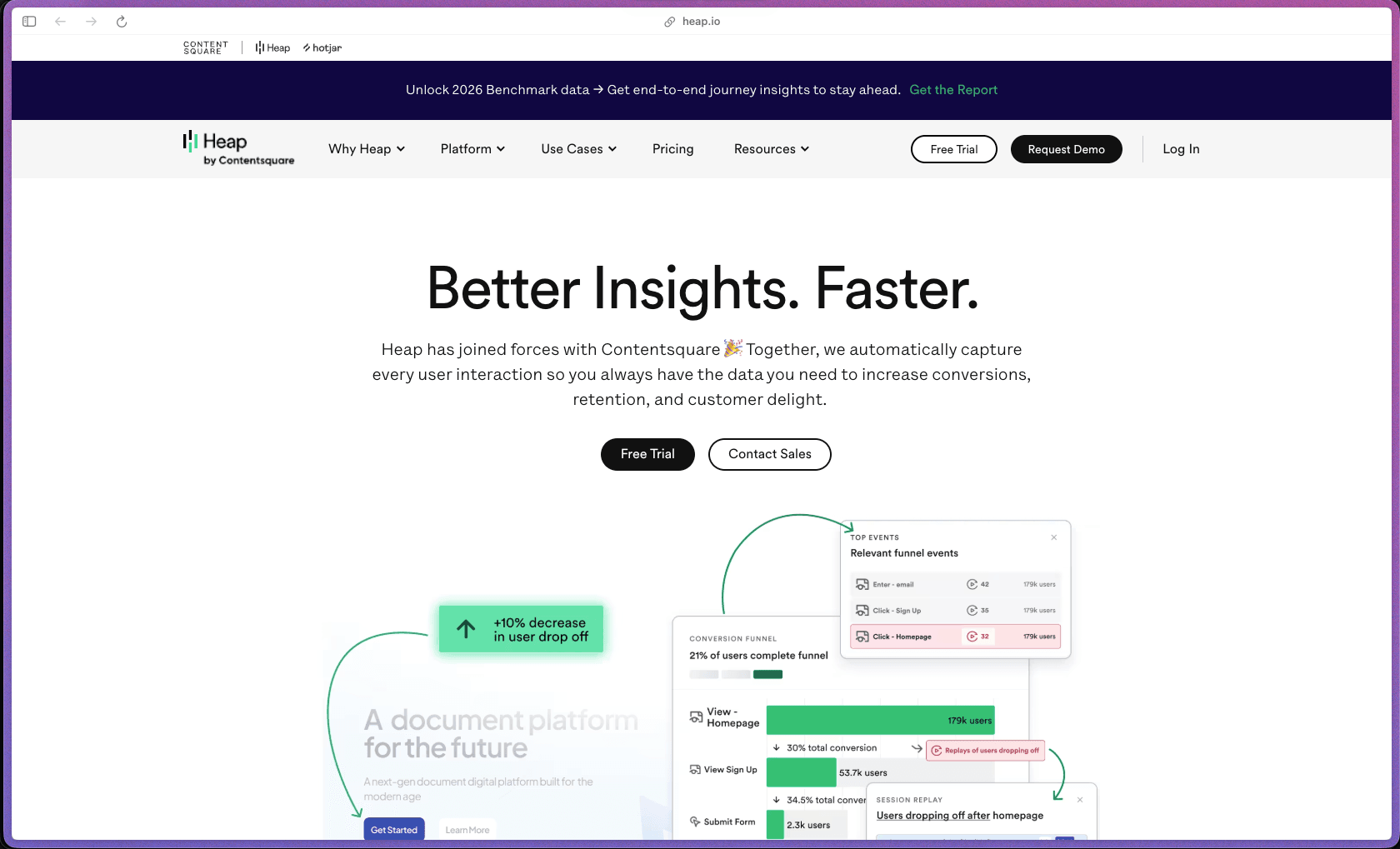
Heap's core distinction is autocapture — a single JavaScript snippet added to a site or app automatically records every user interaction retroactively from day one, meaning teams can answer questions about past user behavior even for events they never explicitly set up tracking for. This solves one of the most common pain points in behavioral analytics: discovering that you didn't instrument an event you now need, requiring you to wait weeks for future data before answering the question. Now part of the Contentsquare family, Heap combines quantitative product analytics, session replay, AI-powered effort analysis, and data warehouse connectivity in a single platform — reducing the number of separate tools needed to understand both what users do and why they do it.
Heap uses a freemium model with a permanently free tier (limited to a defined monthly session volume and 6 months of data history) and paid Growth and Enterprise plans sold as annual subscriptions priced based on session volume — custom pricing applies to paid tiers, requiring a sales conversation. No self-serve purchasing is available for paid plans; the free plan is available immediately without a credit card requirement via the heap.io signup page.
Heap offers a permanently free plan with no credit card required — covering core analytics charts, 6 months of data history, and SSO for teams evaluating the platform before committing to a paid tier. Refund policy for paid plans is not specified on the official site; paid plans require a sales conversation for custom pricing, and buyers should confirm refund and cancellation terms directly with Heap's sales team before signing an annual contract.
Heap is "mature/established" — founded in 2013, the company has been in continuous operation for 12+ years, growing to serve 10,000+ companies and accumulating 1,097 G2 reviews, which is a substantial review body for an enterprise analytics platform. The platform has expanded significantly from its original autocapture-only analytics product to include integrated session replay, AI-powered Sense Chat natural language query, Effort Analysis data science tooling, Heap Connect data warehouse sync, and Contentsquare integration — indicating sustained product investment across a multi-year roadmap. The 2024 acquisition by Contentsquare is a material maturity signal — Heap is now part of an enterprise-grade digital experience platform group rather than operating as a standalone startup, which affects both product development pace and enterprise sales support structure.
- Rated 4.4 out of 5 on G2 from 1,097 verified reviews — making it one of the most reviewed product analytics platforms on G2, with G2 recognizing Heap as a Leader in Product Analytics in its review-based awards.
- Heap is used by over 10,000 companies — a company-stated figure on the official homepage, covering SaaS, e-commerce, financial services, and enterprise digital product teams.
- Notable customers documented through case studies and logos include Twitch, Wayfair, Logitech, Shutterfly, and Casper — representing both consumer and B2B digital product deployments across retail, media, and SaaS categories.
- G2's review summary for Heap specifically calls out automatic event tracking as the platform's most consistently praised feature — with reviewers noting it saves significant time on instrumentation compared to manual event-tagging tools.
- Heap is now part of the Contentsquare group — a recognized enterprise digital experience analytics company — providing organizational infrastructure and product investment backing from a well-capitalized parent company following the acquisition.
- Autocapture technology records every user interaction — clicks, taps, pageviews, form fills, rage clicks, and navigation — from the moment a single JavaScript snippet is added to the site or app, without requiring engineers to manually instrument individual events before data collection begins.
- Retroactive event definition lets you go back to any point in Heap's stored data history and define a new event or segment after the fact — meaning you can answer questions about historical user behavior for actions you weren't explicitly tracking at the time, using data that was already captured by autocapture.
- Visual Labeling allows non-technical team members to define and name tracked events by clicking directly on UI elements in a visual point-and-click interface — without writing tracking code, enabling product managers and marketers to create custom events independently of the engineering team.
- Funnel analysis tracks sequential conversion steps across any defined user flow — showing where users drop off between steps, how long each step takes, and which user segments have higher or lower conversion rates through the funnel.
- Journey maps visualize the actual paths users take through a site or app — showing the most common routes to conversion or abandonment, including unexpected paths users take that weren't part of the intended designed flow.
- Retention analysis tracks whether users return to a defined behavior over time — identifying which actions or features correlate with users becoming long-term engaged customers versus churning after the first session.
- Session replay is integrated natively within the analytics platform — playing back individual user sessions with automatic linking to the specific moment in a session where a funnel drop-off, rage click, or behavioral anomaly occurred, so teams jump directly to the relevant session context without manual search.
- Effort Analysis uses proprietary data science modeling to calculate a quantitative friction score for any flow or interaction — showing which parts of a site or app require the most effort from users to complete, ranked by impact, without requiring manual hypothesis formation.
- Sense Chat (AI copilot) allows any team member to ask natural language questions about product analytics data and receive structured answers — reducing the barrier for non-analysts to extract behavioral insights without building charts or writing queries from scratch.
- Dashboards and charts support line graphs, bar charts, pie charts, table views, and "big number" KPI cards — with resizable report widgets, inline notes, scheduled email delivery of key dashboards, and Slack alert integration for monitoring defined metric thresholds.
- User-level and account-level analytics track individual user sessions and aggregate behavior at the company or account level — covering both B2C product analytics (user-level) and B2B SaaS analytics (account-level, mapping individual user activity to an organizational customer).
- Behavioral cohorting segments users by any combination of actions they have or haven't taken — enabling comparison of feature adoption cohorts, activation behavior by signup source, and retention differences between user segments without predefined segment definitions.
- 100+ integrations connect Heap behavioral data to CRM, marketing automation, customer support, and data infrastructure tools — including Salesforce, HubSpot, Marketo, Segment, Intercom, Zendesk, Amplitude, and Shopify, so behavioral data can enrich records in adjacent systems.
- Heap Connect syncs the full Heap behavioral dataset to cloud data warehouses (Snowflake, BigQuery, Redshift, Azure Synapse) — providing analysts and data engineers with direct SQL access to all autocaptured event data for custom reporting, ML modeling, and cross-system joins without API extraction.
- Server-side event ingestion via Heap's API allows backend events (account creation, subscription upgrade, payment completion) to be sent into Heap alongside client-side autocaptured events — producing a unified user timeline that combines frontend behavioral data and backend business events in a single profile.
- Salesforce and Intercom data import enriches Heap's behavioral user profiles with CRM account data and support ticket history — allowing behavioral analysis to be filtered by customer plan, company size, deal stage, and support interaction history.
- Contentsquare platform integration connects Heap's product analytics and session replay to Contentsquare's broader digital experience intelligence suite — providing access to heatmaps, zone-based analysis, and page performance insights for teams using both platforms.
- Smart Alerts automatically notify teams when a defined metric crosses a configured threshold — covering conversion rate drops, feature adoption spikes, and funnel step degradation, with delivery to email or Slack without requiring manual dashboard monitoring.
- Scheduled dashboard email delivery sends configured dashboards on a defined schedule (daily, weekly, monthly) to designated team recipients — keeping stakeholders updated on key behavioral metrics without requiring them to log in to Heap to check.
- Automatic data governance adaptation updates the data structure automatically when product changes introduce new UI elements or renamed events — maintaining continuity in existing reports and funnels without manual event re-mapping by the data or engineering team.
- Retroactive analysis removes the manual work of "backfilling" data for newly defined events — any event defined today using Visual Labeling or the query builder automatically returns historical data from all previous sessions captured since Heap was installed, without re-running a tracking deployment.
- Pre-built dashboard templates organized by role and industry provide starting points for product, growth, marketing, and e-commerce analytics use cases — reducing the time to first meaningful report for new users who don't want to build all charts from scratch.
- Funnel reports show conversion rates, drop-off rates, time-to-completion per step, and segment breakdowns for any defined sequential flow — with the ability to break down any funnel step by user property, event property, or behavioral cohort.
- Retention reports display the percentage of users who return to perform a defined action over a configurable time window — presented as both a retention table (cohort × time period) and a summarized retention curve for communicating engagement trends.
- Path and journey reports show the full distribution of navigation sequences users take before or after a defined event — revealing the most and least common paths to a goal, including unexpected routes, abandoned sequences, and circular navigation patterns.
- Effort Analysis reports rank digital flows and interaction points by friction score — providing a prioritized list of the highest-impact areas to fix, backed by quantitative effort data rather than qualitative session replay observation alone.
- Individual user timelines allow drilling down to the complete session-by-session behavioral history of any single user — with linked session replay playback, event timestamps, and property values for each interaction in the user's recorded history.
- User properties and event properties from any data source (Heap autocapture, imported CRM data, server-side API, enrichment connectors) can be used as filters, group-by dimensions, and segment definitions in any Heap chart or funnel — enabling highly specific analysis cuts without predefined segment configurations.
- Custom event creation via Visual Labeling or the Heap query interface lets teams define named events from any autocaptured interaction at any granularity — from "clicked any CTA button" to "clicked the specific upgrade button on the billing page when the user had a free plan" — without engineering involvement.
- Role-based access controls manage which team members can view, edit, and administer specific projects, dashboards, and data connections — with user, role, and access management documented as a supported G2 feature category for enterprise deployments.
- Data history window is configurable by plan — with the free plan providing 6 months of retroactive data, and paid plans extending the history window for longer-term behavioral trend analysis.
- Dashboard sharing and report export allow individual charts and dashboards to be shared via link with internal or external stakeholders — with scheduled email reports configurable for any saved dashboard on paid plans.
- SSO (Single Sign-On) is available on all plans including free — supporting enterprise identity provider integration for centralized authentication management without requiring per-user password credentials.
- GDPR and privacy compliance tools are built into the platform — with Heap documenting privacy-focused data capture controls, data deletion capabilities, and compliance configuration options for teams required to manage EU data subject rights.
- Data governance tooling maintains a structured data taxonomy from the moment events are captured — automatically organizing event data into a consistent hierarchy (account > user > session > pageview > event) and adapting the structure as the product changes, reducing schema drift and data quality issues over time.
- User data masking and sensitive data exclusion options allow specific input fields, pages, or interaction types to be excluded from Heap's capture — covering scenarios where password fields, payment card inputs, or personally identifiable information should not be recorded in session data.
- SOC 2 compliance is referenced in Heap's security documentation — providing assurance for enterprise buyers evaluating Heap against organizational security procurement requirements.
- SaaS product managers who need to understand feature adoption, activation flow drop-off, and retention differences between user cohorts — without waiting for an engineering sprint to instrument new tracking events before analysis can begin.
- Growth teams at B2B or B2C digital product companies who need funnel analysis across onboarding, activation, and upgrade flows — with the ability to retroactively analyze historical behavior for new hypotheses without re-deploying tracking code.
- Data analysts and product analytics teams who want to pipe the full behavioral dataset into a Snowflake, BigQuery, or Redshift warehouse via Heap Connect — running custom SQL models and cross-system joins on autocaptured event data without API-based extraction pipelines.
- E-commerce and digital experience teams at mid-market and enterprise companies who want to combine quantitative funnel analysis with session replay cued to specific drop-off moments — eliminating the context-switching between a separate analytics tool and a separate session recording tool.
- UX researchers and product designers who want quantitative evidence for which parts of a flow have the highest friction — using Effort Analysis scores to prioritize redesign work based on measured behavioral difficulty rather than only qualitative usability testing findings.
- Use it for diagnosing unexpected drops in a signup or onboarding funnel when you want to see exactly which step is losing users, which user segments are affected most, and watch session replays of the specific moment of drop-off — without having to first re-instrument tracking and wait for new data.
- Use it for retroactive feature adoption analysis when a product manager wants to know how users engaged with a feature that launched three months ago, using behavioral data that was already captured automatically — even if no specific tracking was set up at launch.
- Use it for identifying high-friction points in a checkout or activation flow when you need a quantitative ranking of which steps are causing the most user effort — using Effort Analysis to prioritize engineering fixes by measured impact rather than gut feel.
- Use it for building a data warehouse behavioral dataset when your data team wants all user interaction events in Snowflake or BigQuery for custom modeling, cohort analysis, and cross-system joins with CRM, billing, and support data — via Heap Connect.
- Use it for enabling non-technical stakeholders to explore product data when PMs, marketers, or customer success managers need to answer their own behavioral questions using natural language via Sense Chat — without requesting analyst time for every ad-hoc query.
- Use it for understanding the real user paths to conversion when your analytics show what percentage of users convert but not which navigation routes the converting users took versus the ones who abandoned — using journey maps to reveal unexpected high-converting and high-abandoning paths.
- Cloud-hosted SaaS platform — Heap is fully cloud-managed with no self-hosted or on-premise deployment option; all data capture, storage, and analysis infrastructure is maintained by Heap/Contentsquare with access via web browser.
- JavaScript snippet installation captures client-side web behavior automatically across all pages where the snippet is present — with no manual event tagging required for standard browser interactions including clicks, form fills, pageviews, and navigation.
- Mobile SDK support covers iOS and Android native apps — extending autocapture to mobile application interactions including taps, swipes, screen views, and in-app navigation flows alongside web analytics in the same Heap account.
- Server-side API enables backend event ingestion — allowing server-generated events (subscription upgrades, payment completions, background job results) to be imported into Heap and associated with the corresponding user's behavioral profile.
- Heap Connect provides direct warehouse integration — syncing the full raw event dataset to Snowflake, BigQuery, Redshift, or Azure Synapse for SQL-based analysis, custom ML models, and cross-system data joins.
- 100+ native integrations cover CRM (Salesforce, HubSpot), marketing automation (Marketo), customer data platforms (Segment), support tools (Intercom, Zendesk), e-commerce (Shopify), and analytics (Amplitude, Contentsquare).
Heap's most direct competitors in the product analytics space are Mixpanel, Amplitude, FullStory, and PostHog — all covering behavioral analytics for digital products, with varying approaches to event tracking, session replay, and data access. Heap's clearest differentiation is the autocapture-plus-retroactive-analysis combination — where Mixpanel and Amplitude require manual event instrumentation before data collection begins (meaning gaps exist for uninstrumented events), Heap captures everything from day one and lets teams define events after the fact from already-stored data, which fundamentally changes the speed and scope of behavioral analysis. Compared to Google Analytics 4 specifically, Heap provides user-level behavioral analysis, account-level analytics for B2B SaaS, session replay, retroactive event definition, and direct warehouse sync — making it more suitable for product analytics use cases where GA4's session-focused, aggregate-first model leaves gaps.
- Heap provides a structured Help Center at help.heap.io covering all platform features — with documentation sections for data capture, charts and analysis, integrations, data governance, security, and the Sense AI tool, organized by task and use case for both new and experienced users.
- Paid plan customers receive dedicated customer success support — with account-based onboarding, named support contacts, and enterprise support options; free plan users have access to the Help Center and community resources without a dedicated success manager.
- The Heap community and Reddit presence (r/analytics) show active user discussion around autocapture configuration, warehouse integration troubleshooting, and comparison questions — with Heap users sharing implementation approaches and the team historically participating in feedback threads.
- Paid plan pricing is not self-serve and not published publicly — custom pricing based on session volume requires a sales conversation before buyers can compare annual cost against alternatives; this makes budget estimation difficult without a direct engagement with Heap's sales team.
- The free plan is limited to a defined monthly session volume and 6 months of data history — teams with higher traffic volumes or who need longer lookback windows for trend analysis will need a paid plan, and the session volume cap on the free plan is not published as a specific number on the current pricing page.
- Reddit and independent review coverage consistently notes that Heap's pricing at scale is significantly higher than entry-level alternatives like PostHog or Plausible — making it more suitable for mid-market and enterprise teams with analytics budgets than for early-stage startups watching spend closely.
- Session replay is integrated but available storage and replay retention limits depend on plan tier — buyers needing extended session replay history should confirm replay retenti
Related Products
Recently Added!
Wrike
Recently Added!
TimeDoctor

Recently Added!
RingCentral

Recently Added!
Retable

Recently Added!
Parallels Desktop

Recently Added!
Pabbly Connect

Recently Added!
Nuelink

Recently Added!
Kit (formerly ConvertKit)
Recently Added!
Intercom

Products With Lifetime Deals
Recently Added!
FluentForms
Recently Added!
Divi Theme
Recently Added!
ConvertPro
Recently Added!
CartFlows
Recently Added!
Bullet Proof Security
Recently Added!
WP Booking Calendar
Recently Added!
BeaverBuilder
Recently Added!
Avada
Recently Added!
Independent Analytics
You Recently Viewed These
Recently Viewed
BitFlows

Recently Viewed
Amelia
Recently Viewed
Dynamic.ooo

Recently Viewed
Microthemer & Amender

Recently Viewed
LifterLMS

Recently Viewed
Masteriyo

Recently Viewed
Zynith SEO
Recently Viewed
Wrike
Recently Viewed
WPMU Dev
Recently Viewed
wpDataTables
Recently Viewed
WP Booking Calendar
Recently Viewed
Webflow