GetResponse
GetResponse

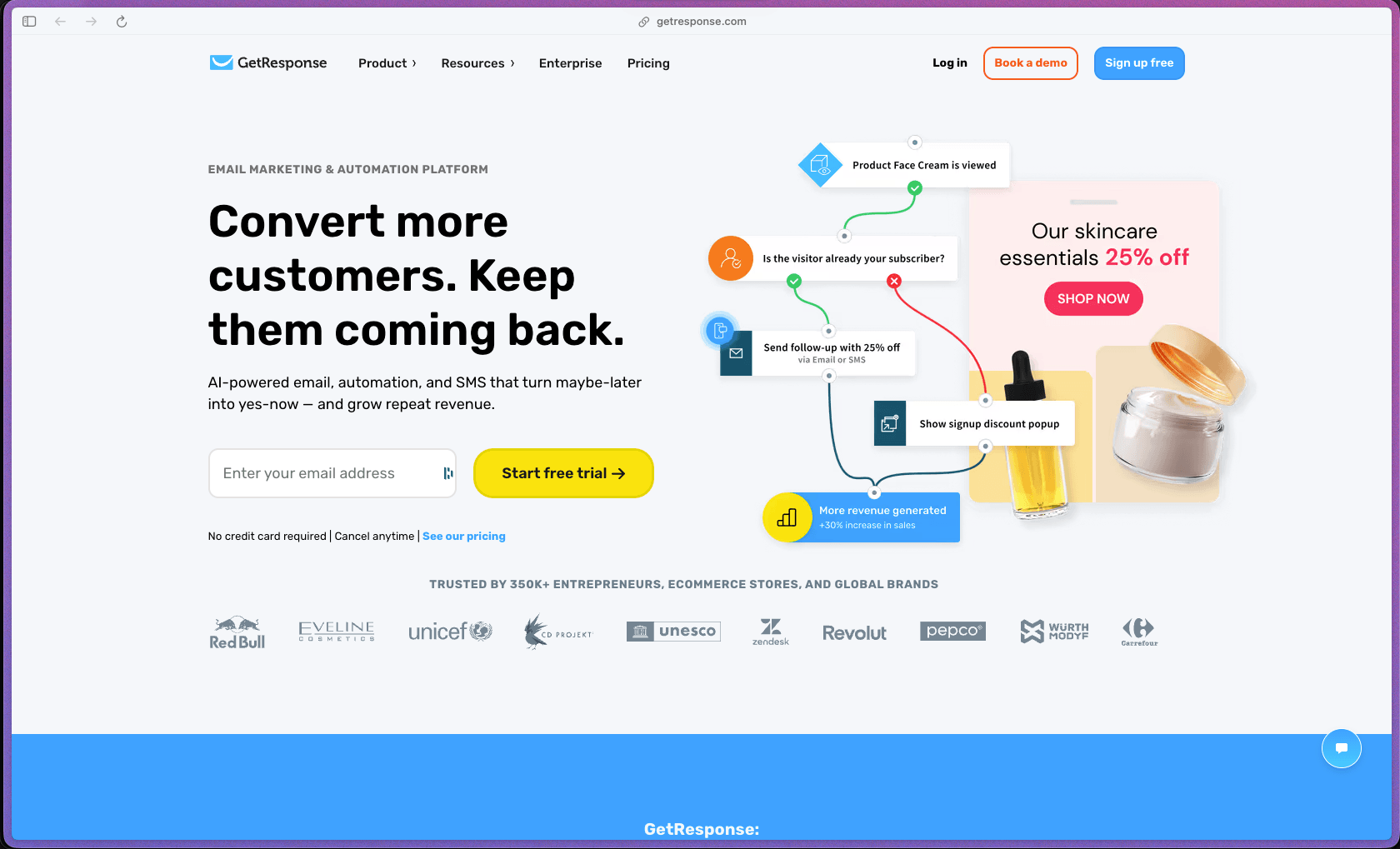
GetResponse covers a notably broad marketing stack for a single subscription—unlimited emails, visual automation workflows, a landing page builder, webinar hosting, forms and popups, SMS, web push notifications, conversion funnels, AI product recommendations, and online course/newsletter monetization—without requiring separate tools for each. Founded in 1997 and now serving 350,000+ customers across 160+ countries with 25+ years of continuous operation, it carries the kind of institutional deliverability infrastructure and platform stability that newer email marketing tools are still building toward. G2 named it a Leader in the email marketing category, and its 4.2/4.3 ratings across Capterra and G2 from 1,000+ combined reviews reflect consistent everyday-use satisfaction rather than launch-week enthusiasm.
GetResponse uses a freemium model with a permanently free plan (up to 500 contacts, limited features) and three paid plans—Starter, Marketer, and Creator—billed monthly or annually on a pay-as-you-grow contact-tier basis, meaning the monthly cost scales as your subscriber list grows. Annual billing offers an 18% discount over monthly billing, and an additional 10% discount is available for completing a defined onboarding checklist; nonprofit organizations can apply for up to 50% off.
GetResponse offers a permanently free plan (up to 500 contacts) that does not require a credit card to access—providing an unlimited-time free evaluation rather than a time-limited free trial. For the first 14 days of the free plan, new accounts receive trial access to premium paid features—allowing evaluation of automation, advanced segmentation, and higher-tier tools before choosing a paid plan. A specific money-back guarantee period for paid plans is not prominently stated in GetResponse's official help documentation—buyers should verify the current refund policy directly with GetResponse before purchasing.
GetResponse is firmly "mature/established"—founded in Poland in 1997 by Simon Grabowski, it has operated for 28+ years as a dedicated email marketing platform, evolving from a newsletter tool into a multi-channel lifecycle marketing platform covering email, SMS, web push, landing pages, webinars, and AI-driven automation. The platform has undergone significant repositioning in 2024–2025, restructuring its pricing plans and deepening its AI feature set with AI email generation, AI product recommendations, AI-powered send time optimization, and a Creator tier for online course and newsletter monetization—indicating active product investment aligned with current market trends rather than a stagnant platform coasting on brand recognition. With 350,000+ customers, documented operation in 160+ countries, G2 Leader status, and 1,000+ combined G2 and Capterra reviews, the depth of social proof reflects genuine scale—not a product in early growth.
- Rated 4.3 out of 5 on G2 and 4.2 out of 5 on Capterra from a combined 1,000+ verified reviews—G2 named GetResponse a Leader in the Email Marketing category in its Grid Report, reflecting both high satisfaction scores and significant market presence.
- GetResponse has operated continuously since 1997—making it one of the longest-standing dedicated email marketing platforms in the market, with 25+ years of deliverability infrastructure development documented in the official help center.
- 350,000+ customers across 160+ countries are documented as GetResponse users—as referenced in official help documentation and independent reviews covering the platform's global scale.
- Venture Harbour published an honest 16-year long-term review of GetResponse in 2026—noting that the 2025 plan restructure changed the product positioning meaningfully and providing longitudinal editorial coverage that goes beyond typical short-term review cycles.
- Forbes, GMass, EmailToolTester, EmailVendorSelection, Encharge, and MailCon have all independently reviewed GetResponse in 2024–2026—confirming broad, consistent independent editorial coverage from well-known marketing software review outlets.
- GetResponse offers nonprofit pricing of up to 50% off standard plan rates—documented in official pricing FAQ, indicating an established institutional pricing program rather than case-by-case discounting.
- Email newsletter editor with drag-and-drop block builder and 100+ pre-designed responsive templates enables creation of promotional, triggered, and lifecycle emails without coding—with an AI-powered subject line and email copy generator, and a dedicated HTML editor available for users who prefer coding custom templates.
- Autoresponders send a configurable sequence of emails to new subscribers at defined time intervals after sign-up—covering welcome series, onboarding sequences, drip campaigns, and any time-based follow-up series without requiring a full automation workflow setup.
- Unlimited landing pages are included on all paid plans—built with a drag-and-drop editor and AI-assisted copy generation, and usable for lead capture, product launches, flash sales, webinar registrations, and course sales without a separate landing page tool subscription.
- Webinar hosting (available on Starter as an add-on; included on Creator) allows users to host, record, and promote live webinars directly within GetResponse—with up to 300 attendees on the Creator plan—supporting lead nurturing webinars, product demos, and paid webinar events without a separate webinar platform.
- Conversion funnels (formerly Autofunnel) provide end-to-end automated sales funnels covering lead magnet delivery, product sales, and webinar promotion—combining landing pages, emails, and payment integrations into a pre-mapped funnel sequence configurable without building each step manually.
- Online course builder and paid newsletter tools (Creator plan) allow users to publish and sell knowledge-based products—video courses, e-books, digital content—directly through GetResponse, positioning it as a content monetization platform rather than only an email marketing tool for Creator-plan subscribers.
- Forms and popups builder creates embedded signup forms, exit-intent popups, scroll-triggered banners, and fixed bars for list growth—configurable with display timing rules and targeting conditions, and connectable to automation workflows on form submission.
- SMS marketing is built directly into the GetResponse platform—enabling transactional and promotional SMS sends as part of multi-channel lifecycle automation workflows alongside email and web push, without a separate SMS marketing platform subscription.
- Web push notifications deliver opt-in browser notification messages to website visitors—allowing re-engagement of users who have left the site without subscribing to email, integrated into the same automation workflows used for email and SMS campaigns.
- A/B testing supports up to 5 simultaneous test variants for email subject lines, from names, email body content, and send time—with the winning variant automatically sent to remaining contacts when the test reaches statistical significance, covering systematic optimization of every email variable.
- Contact list management supports unlimited list segments created from any combination of demographic fields, behavioral signals (email opens, clicks, purchases, page visits), and custom contact fields—enabling precise audience targeting for campaign sends without manual contact export and reimport.
- Transactional email sending (available as an add-on) extends GetResponse beyond marketing emails to cover order confirmations, password resets, and account notifications—keeping transactional and marketing email infrastructure under a single platform account.
- 150+ native integrations connect GetResponse to major platforms including Shopify, WooCommerce, Magento, BigCommerce, WordPress, Zapier, Stripe, PayPal, Google Analytics, Facebook Lead Ads, Salesforce, HubSpot, Slack, and Calendly—covering the most common e-commerce, CRM, and productivity tool stacks.
- Zapier and API access extend GetResponse connectivity to thousands of additional apps outside the 150 native integrations—allowing custom workflow triggers based on GetResponse contact events, form submissions, purchase data, and automation step completions.
- E-commerce platform integrations (Shopify, WooCommerce, Magento, BigCommerce) sync product catalog data, order history, and purchase events directly into GetResponse—enabling product recommendation emails, abandoned cart recovery workflows, and post-purchase sequences driven by actual transaction data without manual data export.
- Facebook and Instagram lead ad integration syncs contacts captured through Facebook and Instagram Lead Ads directly into GetResponse contact lists and automation workflows—eliminating manual CSV export and import between the ad platform and email system.
- Google Analytics integration passes campaign tracking parameters to GetResponse email links—attributing email-driven traffic, conversions, and revenue within Google Analytics without manual UTM parameter configuration for each campaign.
- Visual automation workflow builder maps customer journeys as a drag-and-drop canvas—supporting unlimited trigger types (sign-up, purchase, page visit, tag added, score threshold, email engagement), conditional branching based on contact behavior, and multiple parallel paths for the same automation.
- Behavior-based automation triggers fire workflow steps based on specific customer actions—website page visits tracked via GetResponse's website tracking script, email link clicks, purchase events from connected e-commerce platforms, and custom event data pushed via API—enabling highly contextual messaging rather than only time-based delays.
- AI-powered send time optimization analyzes each individual contact's historical email engagement patterns and automatically adjusts send timing for each recipient to the time they're most likely to open—applied at the individual contact level rather than selecting a single send time for the entire list.
- Abandoned cart recovery automation detects when a connected e-commerce store visitor adds items to their cart and leaves without completing the purchase—triggering a configurable email sequence at defined intervals to recover the sale, pulling the actual cart contents dynamically into the recovery email.
- AI product recommendations personalize email and website content with dynamically generated product suggestion blocks—driven by each contact's browse and purchase history from connected e-commerce data—without manually selecting products for each recommendation email.
- Lead scoring assigns points to contacts based on defined engagement actions (email opens, clicks, website visits, purchases)—and triggers automation actions (notify sales, add tag, move to a different list segment) when a contact's score crosses a defined threshold, supporting automated lead qualification.
- Tag-based automation management applies and removes contact tags automatically based on behavior—allowing automation workflows to segment, personalize, and branch based on dynamically maintained tag states rather than only static list membership.
- Real-time campaign analytics track open rate, click-through rate, unsubscribe rate, bounce rate, spam complaint rate, geographic distribution, and email client breakdown for every email sent—including a comparison between desktop and mobile open rates to inform responsive design decisions.
- E-commerce revenue reporting attributes sales, orders, and revenue to specific email campaigns and automation workflows—providing a direct revenue contribution view for each email in the sequence rather than only engagement metrics.
- Automation workflow analytics display the contact count and conversion rate at each step of every active automation—identifying which specific step has the highest dropout rate and where automation sequences are losing contacts before reaching the conversion goal.
- A/B test performance reporting displays variant-by-variant open rate, click rate, and revenue comparison for active A/B tests—with automatic winner detection and send applied when the defined confidence threshold is reached.
- Webinar analytics (Creator plan) report on attendee registration rates, attendance rates, engagement during the session, and post-webinar email follow-up performance—providing the data to evaluate webinar content effectiveness alongside email campaign performance.
- List growth reports show subscriber acquisition trends over time—tracking new subscriptions, unsubscribes, and net list growth by source (form, import, API, social media integration)—enabling evaluation of which list-building channels are performing.
- Custom contact fields allow any number of additional data fields to be added to contact profiles beyond the standard name and email fields—capturing job title, company, purchase preferences, survey responses, or any business-specific data point needed for segmentation and personalization.
- Dynamic content blocks within email templates show different content sections to different recipients within the same email send—based on contact field values, tags, segment membership, or behavioral data—enabling one email send to deliver personalized messaging to multiple audience subsets.
- Custom domain for landing pages allows GetResponse-built landing pages to be published on your own domain (e.g., offers.yourbusiness.com) rather than a GetResponse subdomain—maintaining brand URL consistency for externally promoted landing pages.
- Multi-user account access (included with Marketer and Creator plans, available as an add-on on Starter) allows multiple team members to share a GetResponse account with role-based permissions—relevant for marketing teams or agencies where more than one person manages campaigns, contacts, and automations.
- White-label email sending (custom sender domain authentication via DKIM and SPF configuration) allows GetResponse emails to be sent from your own authenticated domain—contributing to deliverability and ensuring recipient email clients display your brand name rather than a third-party sender.
- GDPR compliance tools include a consent management framework within GetResponse—covering double opt-in configuration, consent field recording on signup forms, and data export/deletion capabilities allowing businesses to fulfill EU GDPR data subject rights requests for their contacts.
- Double opt-in confirmation email capability requires new subscribers to click a confirmation link in an automated verification email before being added to the active list—reducing spam complaints, improving list quality, and documenting explicit consent for email communication.
- Dedicated IP addresses are available as an add-on for high-volume senders who want full control over their sender reputation—separating their email deliverability from the shared IP pool and applying their own sending history to a dedicated IP address.
- DKIM and SPF sender authentication configuration is available for custom sending domains—verifying that emails sent through GetResponse are authorized by the domain owner, which is required by major inbox providers (Gmail, Yahoo, Microsoft) for reliable inbox delivery and reducing phishing risk to recipients.
- GetResponse is a cloud-hosted SaaS platform—all contact data, campaign content, and automation configuration are stored in GetResponse's own cloud infrastructure; buyers with strict data residency requirements should review GetResponse's data processing documentation, as specific server location and data residency options for standard plans are not prominently detailed on the marketing pages.
- E-commerce stores on Shopify, WooCommerce, or Magento that want automated abandoned cart recovery, AI product recommendation emails, post-purchase sequences, and revenue-attributed campaign reporting—without purchasing a separate email platform and a separate automation tool on top of their e-commerce stack.
- Solo entrepreneurs and small business owners with a growing contact list (500–25,000 subscribers) who want to automate their entire customer communication cycle—welcome series, nurture sequences, promotional campaigns, and re-engagement flows—without needing a developer or marketing ops resource to configure it.
- Content creators, coaches, and online educators on the Creator plan who want to build their email list, send automated nurture sequences, host lead-generation webinars, and sell online courses or paid newsletters from one platform—without maintaining separate tools for email, webinars, and course delivery.
- Marketing agencies managing campaigns for multiple clients who need multi-user access, client account separation, landing page builders, and a feature-complete automation engine—using Marketer or Creator plan multi-seat access to run multiple client workspaces.
- Nonprofit organizations that want a full-featured email marketing and automation platform with a documented 50% discount on standard plan pricing—using GetResponse's nonprofit pricing program to access professional marketing infrastructure at reduced operating cost.
- Use it for building a multi-step welcome and onboarding email sequence when you want every new subscriber or customer to receive a defined series of emails at configured intervals—guiding them from first contact to conversion without manually following up with each new contact.
- Use it for recovering WooCommerce or Shopify abandoned carts when your store is losing revenue to cart abandonment and you want automated, personalized reminder emails containing the customer's actual cart contents to fire within hours of abandonment—without a separate cart recovery plugin.
- Use it for building and publishing a lead capture landing page when you want to run a traffic campaign to a page that collects email addresses in exchange for a lead magnet—feeding new contacts directly into an automated follow-up sequence without a separate landing page tool.
- Use it for hosting lead generation and client nurturing webinars when you want to register attendees, send automated reminder emails before the event, deliver post-webinar recordings, and follow up non-attendees with a replay sequence—all managed within a single platform.
- Use it for segmenting and personalizing campaigns to different audience subsets when you have a contact list with diverse customer types—using behavioral signals, purchase data, and custom fields to send different messaging to different segments without maintaining separate lists for each audience.
- Use it for monetizing a newsletter or knowledge product when you're on the Creator plan and want to charge subscribers for premium newsletter content or sell an online course directly to your email list—without a separate course platform or paid newsletter tool subscription.
- SaaS web application—fully cloud-hosted, accessible via any modern web browser on Mac, Windows, Linux, iOS, and Android; a mobile app is available for iOS and Android for basic campaign and contact management on the go.
- No self-hosted or on-premise option is available—all contact data, email campaign content, landing pages, and automation configurations are stored and processed within GetResponse's cloud infrastructure.
- 150+ native integrations cover e-commerce (Shopify, WooCommerce, Magento, BigCommerce, PrestaShop), CRMs (Salesforce, HubSpot), payment processors (Stripe, PayPal), advertising (Facebook Lead Ads, Google Ads), CMS (WordPress), and productivity tools (Zapier, Slack, Calendly, Google Analytics).
- REST API access enables programmatic contact management, campaign creation, event tracking (website page visits and custom events), and integration with custom internal tools or platforms not covered by native integrations.
- Website tracking script integration allows GetResponse automations to fire based on specific pages a contact visits on your website—extending behavioral trigger capability beyond email interaction signals to web browsing behavior.
- GetResponse WordPress plugin is available for embedding GetResponse forms and popups directly into a WordPress site and synchronizing WordPress site visitors and form submissions with GetResponse contact lists without manual API configuration.
GetResponse's most direct category competitors are Mailchimp, ActiveCampaign, Klaviyo, ConvertKit (now Kit), and Brevo (Sendinblue)—all operating in the email marketing and automation platform space. GetResponse's clearest differentiation from most email-only competitors is the depth of its native non-email feature set—webinar hosting, a landing page builder, conversion funnels, an online course builder, paid newsletter tooling, web push, and SMS are all included within the platform rather than sold as separate tools or requiring Zapier bridges to connect. Compared to Klaviyo (which is more tightly optimized for e-commerce revenue attribution) and ActiveCampaign (which has deeper B2B CRM and sales pipeline functionality), GetResponse's broader toolset and lower entry-level pricing makes it a practical choice for solopreneurs, small businesses, and content creators who want a more complete marketing stack under a single subscription rather than category-leading depth in any single area.
- GetResponse offers 24/7 live chat support and email support on all paid plans—including access to a dedicated support team available around the clock; phone support availability and priority support for higher-tier plans are not prominently differentiated in standard support documentation.
- GetResponse's help center at getresponse.com/help covers every product area in structured tutorial articles—including email creation, automation workflow setup, landing page publishing, webinar configuration, e-commerce integrations, deliverability, billing, and API documentation—with content authored in a step-by-step format suitable for both new and advanced users.
- GetResponse maintains active social communities and a YouTube tutorial channel; independent reviewers including EmailVendorSelection and Encharge note that while the documentation is comprehensive, some advanced automation and API use cases are better covered in community forums and YouTube tutorials than in the official help articles—which reflects a common pattern for large platforms where community-generated content supplements official documentation depth.
- GetResponse's contact billing model uses a "peak subscriber plus contacts added" calculation—meaning you are billed at the higher contact tier if your list exceeds your plan's subscriber count at any point during the billing month OR if total new contacts added exceed your plan limit, even if those contacts later unsubscribe; EmailToolTester's 2026 pricing review specifically notes this billing structure as a reason the platform "could end up costing you more" than the base price suggests for lists with high churn or frequent large imports.
- Webinar hosting is only included on the Creator plan—Starter plan users who want webinar access need to purchase it as a paid add-on rather than having it included in the base plan price; buyers evaluating GetResponse for webinar-based lead generation should verify the current webinar add-on cost alongside the base plan price.
- Downgrading from a paid plan back to the permanently free plan is not possible—once upgraded, the account cannot revert to the free plan; this is documented in the official GetResponse help center and means buyers should plan carefully before upgrading to ensure the paid plan remains the right fit.
- G2 and Capterra reviews note that GetResponse's automation builder, while capable, has a steeper learning curve for complex multi-branch workflows compared to some competitors—multiple reviewers describe the interface as occasionally unintuitive for advanced automation scenarios, with the visual canvas requiring more familiarity to use effectively than simpler tools like Mailchimp or Kit (ConvertKit).
Related Products
Recently Added!
Wrike
Recently Added!
TimeDoctor

Recently Added!
RingCentral

Recently Added!
Retable

Recently Added!
Parallels Desktop

Recently Added!
Pabbly Connect

Recently Added!
Nuelink

Recently Added!
Kit (formerly ConvertKit)
Recently Added!
Intercom

Products With Lifetime Deals
Recently Added!
FluentForms
Recently Added!
Divi Theme
Recently Added!
ConvertPro
Recently Added!
CartFlows
Recently Added!
Bullet Proof Security
Recently Added!
WP Booking Calendar
Recently Added!
BeaverBuilder
Recently Added!
Avada
Recently Added!
Independent Analytics
You Recently Viewed These
Recently Viewed
BitFlows

Recently Viewed
Amelia
Recently Viewed
Dynamic.ooo

Recently Viewed
Microthemer & Amender

Recently Viewed
LifterLMS

Recently Viewed
Masteriyo

Recently Viewed
Zynith SEO
Recently Viewed
Wrike
Recently Viewed
WPMU Dev
Recently Viewed
wpDataTables
Recently Viewed
WP Booking Calendar
Recently Viewed
Webflow