Freshworks
Freshworks

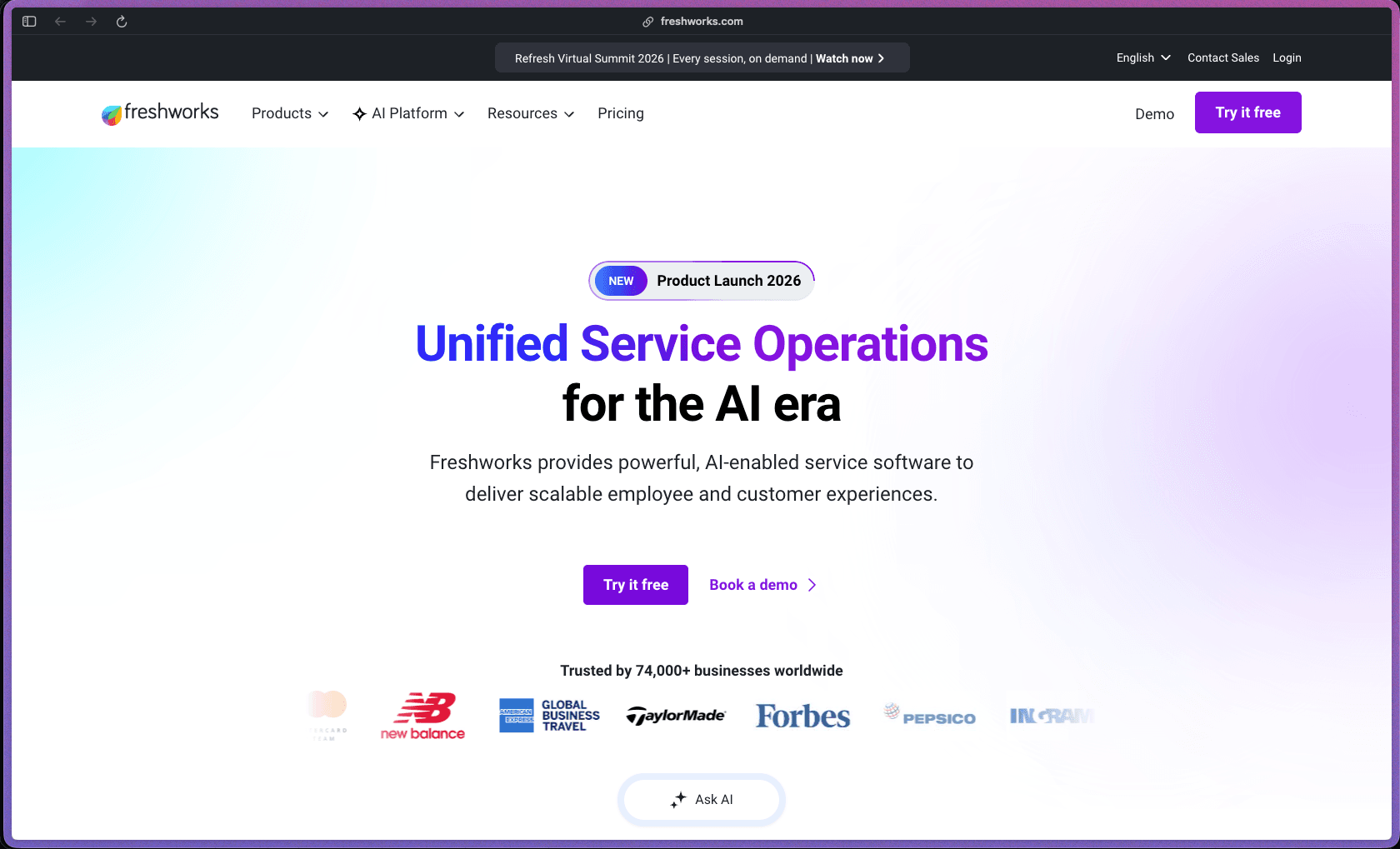
Freshdesk covers the support stack most growing teams actually need—multi-channel ticket management, SLA policies, automation rules, canned responses, a self-service portal, collision detection, and AI-assisted reply suggestions—on a free plan that remains functional for small teams rather than functioning purely as a trial hook. It has 3,744+ G2 reviews for Freshdesk alone (part of Freshworks' 8,728 total G2 reviews), with 100,000+ companies documented as customers including Bridgestone, New Balance, S&P Global, and Sony Music—providing enterprise validation at a product that is genuinely accessible to smaller teams without enterprise-level procurement. Founded in 2010 and publicly traded on NASDAQ (FRSH) since 2021, with $838.8M in 2025 revenue and its first GAAP-profitable year—Freshworks carries the organizational stability of an established public company rather than a VC-funded startup with uncertain runway.
Freshdesk uses a freemium model—a permanently free plan covers up to 10 agents with basic ticketing and email support, while paid plans are billed per agent per month on a monthly or annual subscription basis, with annual billing offering a lower per-agent rate. A 21-day free trial of paid plan features is available without requiring a credit card, reverting to the free plan or the selected paid tier at trial end.
Freshdesk offers a 21-day free trial of paid plan features, with no credit card required to start—the trial provides full access to the selected plan tier before any billing begins. After the trial, accounts automatically revert to the permanently free plan (up to 10 agents) rather than charging automatically—meaning there is no unexpected post-trial charge if you don't actively select a paid plan. A specific money-back guarantee period for paid plan purchases is not prominently stated on the official Freshworks support or pricing documentation available.
Freshdesk is firmly "mature/established"—launched in 2010 as Freshworks' founding product, it has been in continuous production use for 15+ years, serving 100,000+ companies globally in a category (cloud help desk software) where it was one of the early cloud-native entrants competing against legacy on-premise vendors like Zendesk and Salesforce Service Cloud. Freshworks completed its NASDAQ IPO in September 2021 and acquired FireHydrant (an AI-powered incident management platform) in January 2026, introduced ITAM (IT Asset Management) as a new product in April 2026, and added new AI tools to Freshdesk for unified channels and agent productivity in January 2026—indicating active product investment at the platform level rather than maintenance-only releases. The company's 2025 GAAP profitability milestone ($183.7M net income on $838.8M revenue) signals a sustainable business model operating at enterprise scale—relevant context for buyers evaluating long-term platform stability.
- Freshdesk carries 3,744+ verified G2 reviews with consistent praise for ease of use, ticket management workflow, and automation features—making it one of the highest-reviewed help desk products on G2 by review volume.
- Freshworks as a company holds 8,728 total G2 reviews across all products with a 4.5/5 aggregate star rating—reflecting broad positive sentiment across its full product portfolio.
- Nearly 75,000 companies worldwide are listed as Freshworks customers across the full product suite—including named enterprise accounts Bridgestone, New Balance, S&P Global, and Sony Music.
- Freshworks reported $838.8 million in 2025 annual revenue and achieved GAAP profitability for the first time in 2025—publicly disclosed as a NASDAQ-listed company (ticker: FRSH), providing financial transparency unusual among SaaS vendors at this scale.
- Capterra Canada reviewers describe Freshdesk as the system they use for both phone and email inquiries—noting it makes handling customer queries more organized and manageable at a team level.
- TechRadar's review of Freshworks describes the CRM product as "excellent" and "best suited for small commercial businesses and solopreneurs," reflecting positive independent editorial coverage across the product suite.
- Unified ticket inbox consolidates customer queries arriving via email, web portal, phone, live chat, social media (Twitter/X, Facebook), and WhatsApp into a single shared inbox—so support agents handle all channels from one screen without switching between separate tools for each channel.
- SLA (Service Level Agreement) policy configuration defines response and resolution time targets per ticket priority level—automatically escalating tickets that are approaching or have breached their SLA deadline to supervisors, ensuring no customer query is overlooked due to volume.
- Shared team inbox with collision detection shows agents when another team member is already viewing or responding to the same ticket—preventing two agents from simultaneously drafting responses to the same customer without either knowing, eliminating duplicate or conflicting reply scenarios.
- Knowledge base and self-service portal lets teams publish help articles, FAQs, and solution guides that customers can search before submitting a ticket—reducing inbound ticket volume on common questions while providing 24/7 self-service coverage outside support hours.
- Canned responses store pre-written reply templates for frequently asked questions—allowing agents to respond to common queries by selecting a saved reply rather than drafting each response from scratch, reducing per-ticket handle time.
- Freshdesk Omni (the upgraded omnichannel tier) adds AI-first capabilities including AI-assisted reply suggestions, conversation summarization, and automated resolution recommendations—reducing the cognitive load on agents handling high ticket volumes across multiple channels simultaneously.
- Agent collision detection and ticket merging allow supervisors to identify and merge duplicate tickets from the same customer across different channels—presenting a single unified thread to the assigned agent rather than multiple disconnected conversations about the same issue.
- Ticket satisfaction surveys send automated CSAT (Customer Satisfaction Score) surveys after ticket resolution—collecting customer feedback at the individual ticket level to surface agent performance data and identify recurring dissatisfaction patterns.
- Freshservice (separate product) extends the platform to internal IT service management—covering incident management, asset tracking, change management, and service catalog for IT teams managing internal employee support rather than external customer support.
- Freshsales Suite (separate product) adds a sales CRM for lead management, deal pipeline tracking, and marketing automation—allowing organizations to run customer service (Freshdesk) and sales (Freshsales) from within the same Freshworks account with shared contact data.
- 150+ marketplace integrations connect Freshdesk to tools including Slack, Microsoft Teams, Salesforce, HubSpot, Jira, Shopify, WooCommerce, Zoom, Google Analytics, Trello, and Zapier—covering the most common business tool stacks without requiring a custom integration build.
- Freshworks Marketplace allows third-party developers to build and publish apps extending Freshdesk functionality—giving buyers access to a continuously growing integration and extension library beyond the 150 native integrations.
- Freshchat integration (Freshworks' messaging product) connects live chat conversations from the website or mobile app into the Freshdesk ticket workflow—routing chat sessions to support agents in the same ticket interface used for email and portal tickets.
- Freshcaller integration (Freshworks' cloud call center product) links inbound and outbound phone calls to Freshdesk ticket records—creating call-linked ticket entries automatically when an agent handles a phone inquiry, so call context is preserved in the ticket history without manual entry.
- REST API access allows custom integrations, data export, ticket creation from external systems, and programmatic agent management—documented at developers.freshworks.com using a consistent SDK (FDK) that works across all Freshworks products, making cross-product integration development more predictable.
- Ticket routing automation assigns incoming tickets to specific agents or teams based on configurable rules—source channel, keywords in the subject line, customer language, customer company, or any custom ticket property—eliminating manual assignment queues for high-volume support teams.
- Scenario automation lets agents trigger a predefined set of ticket actions (assign, tag, set priority, send reply, set status) in one click—condensing multi-step ticket management actions that would otherwise require navigating several menus into a single action per ticket.
- Time-triggered automation runs scheduled actions on tickets that meet defined conditions—automatically escalating tickets that have been open for more than N hours, sending follow-up replies to customers who haven't responded in N days, or closing tickets that have been in a "resolved" state for a defined period without reopen.
- AI-powered reply suggestions (Freshdesk Omni) analyze the content of incoming customer messages and suggest contextually relevant canned responses or knowledge base articles—reducing the time agents spend searching for the right reply template for each new query type.
- Auto-responders send instant acknowledgment emails to customers immediately on ticket creation—confirming the query was received and providing a ticket number for reference, which reduces repeat inbound "did you receive my email?" follow-ups during periods of high ticket volume.
- Ticket volume and trend reports display daily, weekly, and monthly ticket counts by channel, priority, status, and assigned agent—giving support managers a historical view of demand patterns to inform staffing decisions and SLA target calibration.
- Agent performance reports track individual agent metrics including tickets resolved, first response time, resolution time, CSAT scores, and SLA compliance rate—providing the data support managers need to identify high performers and agents who need coaching.
- CSAT and customer feedback dashboards aggregate ticket satisfaction survey responses by agent, team, time period, and ticket category—surfacing patterns in customer satisfaction levels across different support scenarios and agent groups.
- Freshdesk Analytics (available on higher-tier plans) provides a customizable reporting dashboard—allowing support managers to build custom reports combining ticket, agent, and satisfaction data by any dimension available in the ticket record without waiting for a monthly export.
- Custom ticket fields allow additional data fields to be added to the ticket form—capturing information specific to your business (order number, product model, account tier, geographic region) that agents need to resolve tickets efficiently without asking follow-up questions.
- Custom ticket views allow each agent or team to create filtered, sorted ticket list views based on any combination of ticket properties—so agents see only the tickets relevant to their role, priority level, or assigned team without navigating a shared queue containing all tickets.
- Multi-language support portal allows the self-service knowledge base and ticket portal to be displayed in the customer's preferred language—covering multilingual support operations for businesses with globally distributed customer bases.
- Custom email domain allows outbound ticket reply emails to be sent from your own branded email address (e.g., support@yourbusiness.com) rather than a Freshdesk-subdomain address—maintaining brand consistency in all customer-facing email communications.
- Custom roles and permissions allow granular agent access control—restricting specific agents to specific ticket queues, knowledge base editing, reporting access, or administrative settings—so team leads and junior agents have access scoped to their responsibilities.
- Freshworks is a publicly traded company (NASDAQ: FRSH) subject to SEC disclosure requirements and public financial reporting—providing a level of organizational transparency and accountability not available from private SaaS vendors.
- Single Sign-On (SSO) support allows companies to integrate Freshdesk with their existing corporate identity provider (Google Workspace, Microsoft Entra ID, Okta, or SAML 2.0-compatible systems)—enabling centralized employee access management and removing the need for separate Freshdesk password management.
- IP whitelisting (available on higher-tier plans) restricts agent access to the Freshdesk portal to defined IP address ranges—preventing access from unrecognized networks as an additional authentication layer for teams handling sensitive customer data.
- Data residency options allow organizations in certain regions to select where their Freshdesk data is stored—relevant for GDPR compliance and regional data sovereignty requirements in the EU and other regulated markets.
- GDPR compliance documentation and Data Processing Agreements (DPAs) are available from Freshworks for organizations handling EU personal data under GDPR obligations—documented at the Freshworks Trust Center and accessible on request.
- Audit logs (available on higher-tier plans) record agent activity, configuration changes, and administrative actions with timestamps and user attribution—providing the event trail required for internal compliance review or post-incident investigation.
- E-commerce businesses receiving 50–500+ customer support tickets per day across email, chat, and social channels who need tickets from all channels visible in one agent inbox—with automation routing orders, returns, and complaints to the right team without manual queue management.
- SaaS companies and software vendors who need a tiered support structure—a self-service knowledge base for common how-to questions, a standard ticket queue for issues, and an escalation path for critical bugs—without building three separate tools for each tier.
- Growing customer support teams of 5–50 agents who have outgrown email-only support (a shared Gmail or Outlook inbox) and need visibility into who is working on what ticket, SLA tracking per ticket priority, and CSAT measurement per agent.
- SMBs and startups that want a functional free help desk for up to 10 agents without committing to a paid subscription immediately—using Freshdesk's permanently free plan to build support infrastructure before their ticket volume justifies the per-agent cost of a paid tier.
- IT teams at mid-market companies that need both customer-facing support (Freshdesk) and internal employee IT support (Freshservice) within a unified Freshworks account—sharing contact data, workflows, and a common admin interface across both support functions.
- Use it for consolidating multichannel customer support into a single ticket queue when your team currently manages separate inboxes for email, Facebook DMs, Twitter mentions, WhatsApp messages, and live chat—and tickets regularly fall through the gaps between channels.
- Use it for enforcing SLA response and resolution time targets when you have commitments to customers about how quickly queries will be answered—and need automatic escalations and deadline alerts when tickets approach their SLA breach threshold.
- Use it for building a customer self-service knowledge base when you want to reduce inbound ticket volume by giving customers searchable answers to the 20–30 questions your support team answers repeatedly, available 24/7 without agent involvement.
- Use it for tracking agent and team support performance when you need CSAT score data, first response time metrics, and ticket resolution time by agent—to provide objective performance data for team reviews and SLA compliance reporting to stakeholders.
- Use it for managing a free 10-agent helpdesk when you're an early-stage startup or small business that needs structured ticket management and can't yet justify per-agent monthly subscription costs—using Freshdesk's free plan as a functional support tool until ticket volume makes paid features necessary.
- Use it for running IT service management and customer support from one vendor when your organization wants both Freshdesk (customer-facing tickets) and Freshservice (internal IT incidents and asset management) under a single Freshworks contract with shared SSO, billing, and admin infrastructure.
- SaaS web application—fully cloud-hosted, accessible via any modern browser on Mac, Windows, Linux, iOS, and Android with no server installation required; mobile apps (iOS and Android) are available for agents managing tickets on the go.
- Freshdesk is one product within the Freshworks multi-product suite—accounts can activate additional Freshworks products (Freshchat, Freshcaller, Freshsales, Freshservice) within the same organizational account, with shared contact records and cross-product workflows available at higher plan tiers.
- 150+ marketplace integrations cover major CRMs, project management tools, e-commerce platforms, and communication tools—including Salesforce, HubSpot, Slack, Microsoft Teams, Jira, Shopify, WooCommerce, Zapier, Zoom, Google Analytics, and Trello.
- REST API documented at developers.freshworks.com using the Freshworks Development Kit (FDK)—supporting webhook-based integrations, custom app development, and programmatic ticket management for enterprise and developer-led custom integrations.
- Single Sign-On (SSO) supports SAML 2.0, Google Workspace, and Microsoft Entra ID—enabling corporate identity provider integration for agent access management.
- Data center locations available for regional data residency selection—relevant for EU GDPR compliance and regional data sovereignty requirements.
Freshdesk's most direct competitors are Zendesk, Intercom, Help Scout, and Zoho Desk—all operating in the cloud customer support platform category. Freshdesk's most commonly cited positioning advantage over Zendesk is pricing accessibility—G2 and Capterra reviewers frequently describe it as providing comparable core helpdesk functionality at a lower per-agent cost, with a genuinely functional free tier that Zendesk's current plans do not offer. The Freshworks multi-product ecosystem (Freshdesk + Freshchat + Freshcaller + Freshsales + Freshservice) offers organizations a path to consolidating customer support, sales, IT, and telephony under a single vendor relationship—which is an organizational simplicity argument that point solutions like Help Scout or pure chat tools like Intercom cannot match.
- Freshworks offers 24/7 in-product chat support for Freshdesk Omni and Freshchat subscribers, with 24/5 live chat available for standard plans—supplemented by email support; phone support and dedicated account management are available at higher plan tiers and enterprise contracts.
- Documentation at support.freshworks.com and specific product help portals covers ticket setup, automation rules, SLA configuration, knowledge base publishing, API integration, SSO setup, and GDPR compliance—with structured solution categories for each Freshworks product maintained by a dedicated documentation team.
- The Freshworks Community portal connects users worldwide for peer-to-peer help, feature request voting, and product announcements—noted on the Freshworks support page as a supplementary resource; G2 reviewers note that for standard plan holders, documented self-service and community resources are the primary support touchpoints rather than a dedicated technical account manager.
- Freshdesk's free plan, while functional, restricts access to automation rules, SLA policies, custom reports, and some integration depth—teams that need automation routing, SLA tracking, or CSAT surveys must upgrade to a paid tier; the feature comparison between free and paid plans is worth reviewing carefully before assuming the free plan will cover a growing team's full operational needs.
- Trustpilot reviews for Freshdesk show a notably lower average score than G2 and Capterra—with Trustpilot reviewers more frequently citing issues with Freshworks' own customer support quality for subscribers, billing disputes, and account management responsiveness; this discrepancy between platform review scores and Trustpilot scores is worth noting for buyers who weigh vendor support quality heavily.
- Freshworks is a multi-product platform with separate per-product pricing—organizations that want Freshdesk + Freshchat + Freshcaller + Freshsales may find the combined per-agent subscription costs across products add up to a higher total than the individual product pricing pages initially suggest; budget planning should account for the total Freshworks account cost rather than a single product cost in isolation.
- Freshdesk's advanced reporting and analytics features (Freshdesk Analytics with custom report building) are gated behind higher-tier plans—teams that need fully customizable reporting dashboards beyond the standard pre-built reports should verify that the plan tier they're evaluating includes Analytics access before committing.
Related Products
Recently Added!
Wrike
Recently Added!
TimeDoctor

Recently Added!
RingCentral

Recently Added!
Retable

Recently Added!
Parallels Desktop

Recently Added!
Pabbly Connect

Recently Added!
Nuelink

Recently Added!
Kit (formerly ConvertKit)
Recently Added!
Intercom
Products With Lifetime Deals
Recently Added!
FluentForms
Recently Added!
Divi Theme
Recently Added!
ConvertPro
Recently Added!
CartFlows
Recently Added!
Bullet Proof Security
Recently Added!
WP Booking Calendar
Recently Added!
BeaverBuilder
Recently Added!
Avada
Recently Added!
Independent Analytics
You Recently Viewed These
Recently Viewed
BitFlows

Recently Viewed
Amelia
Recently Viewed
Dynamic.ooo

Recently Viewed
Microthemer & Amender

Recently Viewed
LifterLMS

Recently Viewed
Masteriyo

Recently Viewed
Zynith SEO
Recently Viewed
Wrike
Recently Viewed
WPMU Dev
Recently Viewed
wpDataTables
Recently Viewed
WP Booking Calendar
Recently Viewed
Webflow