Drip
Drip

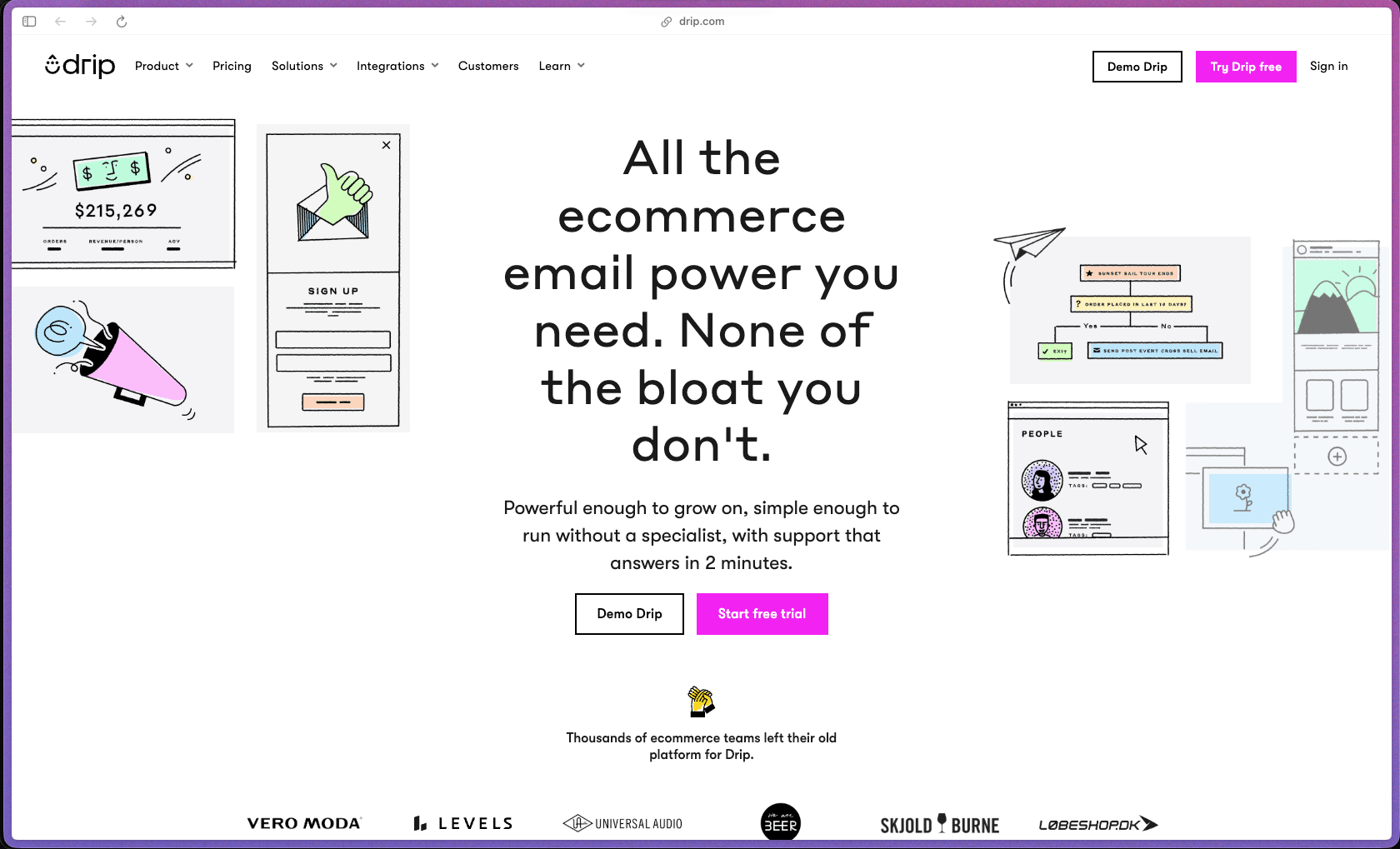
Drip's positioning as an ecommerce-only email and automation platform—rather than a general-purpose email tool—means its segmentation, workflow templates, and integrations are built specifically around purchase events, browsing behavior, and customer lifetime value data from Shopify and WooCommerce, not retrofitted from a broader marketing platform. The flat, all-features-included pricing model at every contact tier removes the frustration of discovering that key features—like A/B testing, advanced segmentation, or automation—are paywalled on a higher tier as your list grows. With 475 verified G2 reviews averaging 4.4 out of 5 and release notes updated through 2026, the platform demonstrates both user adoption and active, sustained product development.
Drip uses a single-tier, usage-based subscription model—pricing scales based on the number of contacts in your account, with all features included regardless of contact count, billed monthly or annually (annual billing includes a discount). A 14-day free trial is available with no credit card required, allowing full platform access before committing to a paid plan.
Drip offers a 14-day free trial with no credit card required, giving full access to the platform before any payment is taken. A formal money-back guarantee policy is not prominently specified on the official site—buyers who require a post-purchase refund commitment should confirm terms with Drip's support team before purchasing.
Drip is "mature/established"—the platform was founded in 2013, acquired by Leadpages in 2016, and later reacquired independently, giving it over a decade of continuous operation and refinement specifically within the email marketing and automation category. The product has undergone deliberate repositioning from a general marketing automation tool to a purpose-built ecommerce platform—a strategic shift visible in its Shopify and WooCommerce integration depth, ecommerce-specific workflow templates, and customer lifetime value reporting capabilities. Active development continues through 2026 with documented monthly release cadence, confirming the platform is not in maintenance mode but under active product investment.
- Rated 4.4 out of 5 on G2 from 475 verified reviews, with consistent positive feedback on workflow flexibility, Shopify integration depth, and segmentation capabilities.
- Findstack aggregates 459 real user reviews of Drip across platforms, with reviewers citing ecommerce-specific features as a primary reason for choosing Drip over general-purpose email tools.
- Drip's integrations page lists 200+ ecommerce and marketing tool integrations, with Shopify and WooCommerce listed as flagship native connections—indicating meaningful platform adoption within the ecommerce ecosystem.
- Drip's release notes page (updated March 2026) shows a consistent cadence of feature releases and improvements throughout 2025 and into 2026—including enhanced Shopify triggers, WooCommerce account updates, embedded forms, and email metrics improvements—reflecting an actively developed rather than a static product.
- Drip is described on its ecommerce page as being trusted by thousands of B2C business owners and marketers—a figure the official site uses without a specific verified number, which is noted here for transparency.
- The drag-and-drop visual email builder includes 50+ themed templates, reusable content blocks, and live customer data personalization—letting you design and send branded emails without coding while automatically populating dynamic content (first names, product recommendations, purchase history) per recipient.
- Dynamic segmentation allows you to build and automatically update audience segments based on real-time ecommerce behaviors—such as purchase frequency, total spend, product browsed, cart abandoned, and days since last order—so your segments reflect who your customers actually are right now, not at the time of manual list export.
- Onsite campaigns (pop-ups and embedded forms) capture new subscribers directly on your website with display targeting based on visitor behavior—exit intent, time on page, page URL, scroll depth—without requiring a separate pop-up or lead capture tool.
- A visual workflow builder lets you map multi-step automation sequences using a point-and-click interface—connecting triggers (purchase, cart abandonment, email click, browsing behavior) to actions (send email, add tag, move to segment, notify team) across email and onsite channels in one view.
- 20+ pre-built ecommerce workflow templates cover the most common customer lifecycle scenarios—welcome series, abandoned cart, abandoned browse, post-purchase follow-up, win-back, and loyalty program enrollment—letting teams launch proven automation sequences without starting from a blank workflow.
- A built-in ecommerce CRM profile is automatically created for each contact, aggregating their full purchase history, browsing activity, email engagement, lifetime value, and predictive churn score—giving you a consolidated customer view without needing a separate CRM tool for contact-level marketing decisions.
- Revenue attribution reporting at the campaign and workflow level shows how much revenue each email or automation sequence has generated—connecting marketing activity directly to store sales so you can make resource decisions based on actual ROI rather than open and click rates alone.
- Shopify integration connects natively with a one-click setup—syncing customer data, purchase events, product catalog, and order history from your Shopify store to Drip in real time, enabling purchase-triggered and browse-triggered automations without manual data imports or Zapier bridging.
- WooCommerce integration connects your WordPress store to Drip via the official Drip WooCommerce plugin (available on WooCommerce.com), syncing customer lists, purchase events, and lifetime value data—enabling the same behavior-triggered automation capabilities available to Shopify stores.
- Facebook Custom Audiences integration allows Drip's segments to be automatically synced as Facebook ad audiences—enabling retargeting campaigns that target, for example, "customers who purchased once but not in 90 days" with Facebook ads without manual audience exports and uploads.
- 200+ third-party integrations cover loyalty platforms (LoyaltyLion, Smile.io), review tools (Junip), payment processors (Authorize.net, FastSpring, Chargify/Maxio), lead capture tools (OptinMonster, Leadpages), webinar platforms (Demio, EasyWebinar), scheduling tools (Acuity, Calendly), and CRM platforms (HubSpot, Insightly, Close)—allowing Drip to fit into existing tool stacks without replacing other tools in the workflow.
- A full open API and webhook system are available on all plans, providing developer access to all Drip data and event streams for custom integrations, internal tool connections, and advanced automation use cases beyond the native integration library.
- Zapier, IFTTT, Integrately, Integromat (Make), and ApiX-Drive are all listed as supported integration middleware platforms, extending Drip's connectivity to thousands of additional tools without direct native integration required.
- Date-based workflow triggers allow automations to fire based on specific calendar dates or date-relative conditions (X days before subscription renewal, Y days after purchase, Z days since last visit)—enabling anniversary campaigns, subscription nudges, and time-sensitive lifecycle sequences without manual scheduling.
- Social media retargeting automation builds and updates Facebook Custom Audiences directly from Drip workflow steps—allowing a workflow to automatically add a customer to a Facebook retargeting audience when they meet a condition (e.g., browse a product but don't purchase) without requiring manual ad audience management.
- Multi-step post-purchase sequences can be built to automatically request reviews, enroll customers in loyalty programs, send product usage tips, and trigger win-back emails at defined intervals after an order—all running in the background without requiring manual campaign sends.
- Subscriber preference management automation lets customers self-select the type of content they want to receive from your brand—automatically routing them into the appropriate segments and workflows based on their selections, reducing unsubscribes from irrelevant content.
- Product price drop notifications automatically email customers who viewed or wishlisted a product when that product's price decreases—triggering personalized conversion-focused emails based on real-time catalog data without manual monitoring or sending.
- Revenue attribution reporting connects each email campaign, automation workflow, and individual message send to actual store revenue—showing total attributed revenue, revenue per recipient, and conversion rate for every marketing activity so you can identify what's working based on dollars, not just engagement metrics.
- An email-only attribution model is available for teams who want to track revenue driven exclusively by email channel activity, separately from other channel touchpoints—giving a cleaner view of email's specific contribution to revenue without cross-channel attribution blending.
- Single Email Campaign Dashboard provides a consolidated view of performance metrics for individual campaign sends—including delivered, opened, clicked, unsubscribed, and revenue metrics—in one screen rather than requiring navigation across multiple report pages.
- Contact-level engagement data tracks each subscriber's open history, click history, purchase events, browsing behavior, and predictive churn risk score within their CRM profile—giving marketers the individual-level context needed to make segmentation decisions without exporting data to a separate analytics tool.
- Workflow-level conversion tracking monitors goal completion (e.g., "made a purchase," "clicked a specific link") within each automation workflow, reporting conversion rates per step so you can identify where customers drop off in a sequence and optimize accordingly.
- Custom fields allow you to store and use any additional data about your contacts—beyond standard ecommerce fields—within segmentation conditions, email personalization tokens, and workflow triggers, covering unique business data models that don't fit standard out-of-the-box fields.
- Sub-accounts are available on all paid plans—allowing agencies or businesses managing multiple brands or stores to keep separate account environments within one Drip subscription, without paying for entirely separate accounts per brand.
- Embedded forms offer full CSS control and GDPR-friendly consent design options (added in late 2025)—allowing forms to match your site's visual design precisely and include compliant opt-in disclosure language without developer customization overhead.
- A/B testing on email campaigns lets you test subject lines, sender names, and email content variations against portions of your audience before sending the winning version to the full segment—available within the standard email sending workflow.
- Drip is GDPR-compliant and provides tools for managing subscriber consent, data subject access requests, and contact data deletion—covering the core compliance requirements for stores selling to EU customers without requiring a separate consent management platform.
- Embedded forms include GDPR-friendly consent checkbox design options as of the late 2025 product update—allowing opt-in forms to collect verifiable, compliant consent at the point of subscription.
- All Drip accounts include standard platform security infrastructure (HTTPS, encrypted data transmission); specific details on SOC 2 compliance, data residency options, or enterprise security certifications are not prominently documented in publicly available materials—buyers with formal compliance requirements should contact Drip's support team for documentation.
- Shopify store owners running 1,000–50,000 contacts who want email automation triggered by actual store behavior (cart abandons, product browsing, purchase frequency) rather than manually scheduled campaigns sent to static lists.
- WooCommerce-based ecommerce brands that need behavior-triggered lifecycle automation (welcome series, post-purchase, win-back) synced directly from their WordPress store without building custom Zapier bridges to connect their store data to their email tool.
- Direct-to-consumer (DTC) product brands with repeat-purchase potential—subscription boxes, consumables, apparel—who need customer lifetime value tracking, predictive churn scoring, and loyalty program automation to maximize revenue per customer.
- Lean marketing teams (1–5 people) at funded ecommerce startups who need enterprise-level segmentation and automation depth without hiring a dedicated marketing operations specialist to configure and maintain a complex platform.
- Ecommerce agencies managing email marketing for multiple DTC clients who need sub-account support (multiple brands in one subscription) and workflow templates that can be adapted across accounts without building every automation from scratch.
- Use it for abandoned cart recovery when your Shopify or WooCommerce store loses revenue from shoppers who add products to their cart and leave—setting up a multi-step timed email sequence that automatically follows up and recovers a portion of those sales.
- Use it for post-purchase lifecycle marketing when you want to automatically send product usage emails, review requests, loyalty program invitations, and repeat purchase prompts at defined intervals after an order—without managing each follow-up manually.
- Use it for building dynamic customer segments when you need to group customers by purchase frequency, total spend, product category purchased, or time since last order—and automatically move customers between segments as their behavior changes.
- Use it for running Facebook retargeting campaigns driven by email behavior when you want customers who opened but didn't purchase to see coordinated Facebook ads automatically—without manually exporting lists and uploading audiences to Facebook Ads Manager.
- Use it for win-back campaigns when customers haven't purchased in a defined number of days and you want an automated reengagement sequence to run—with a special offer, product reminder, or brand story email—triggered without manual list pulls or scheduled sends.
- Use it for growing your email list with onsite campaigns when you want behavior-triggered pop-ups and embedded forms capturing subscribers based on exit intent, scroll depth, or time on page—without adding a separate pop-up tool to your tech stack.
- Cloud-hosted SaaS platform accessible via web browser—no software installation required; all campaign management, automation building, segmentation, and reporting is browser-based at app.drip.com.
- Shopify integration connects natively via a one-click setup directly within the Drip account dashboard—no developer involvement or third-party connector required.
- WooCommerce integration connects via the official Drip for WooCommerce plugin, requiring WooCommerce 3.5+ and PHP 5.4+ on a self-hosted WordPress site.
- Open API with REST architecture and webhook support are available on all plans—enabling custom integrations, data pipelines, and developer-built connections to internal tools or data warehouses.
- 200+ native third-party integrations cover ecommerce platforms (Shopify, WooCommerce, Magento, BigCommerce, Gumroad, SamCart, FastSpring), loyalty tools (LoyaltyLion, Smile.io), review platforms, payment processors, CRMs, landing page builders, and integration middleware (Zapier, Make/Integromat, IFTTT, Integrately).
- Sub-accounts are supported natively on all paid plans—multiple brand or store accounts manageable under a single Drip subscription without separate login credentials per account.
Drip's most meaningful differentiation from general-purpose email tools like Mailchimp, ActiveCampaign, or Klaviyo is its deliberate focus exclusively on ecommerce use cases—all segmentation logic, workflow templates, integrations, and revenue reporting are structured around purchase data and customer lifetime value rather than generic contact and engagement metrics. Compared to Klaviyo specifically—which targets a similar ecommerce audience—Drip's flat all-features-included pricing model (one plan, all features, scaling only by contact count) avoids the per-feature tier gates that Klaviyo uses, which can make total cost harder to predict as a list grows. For ecommerce brands that find Mailchimp insufficiently specialized for purchase-behavior automation and find Klaviyo's pricing structure difficult to forecast, Drip offers a middle path: specialized ecommerce tooling at transparent, predictable contact-based pricing.
- Support is available via email for all paid accounts; chat support is also offered (noted as "chat and email support" in Drip's own pricing feature list), though specific response time commitments are not publicly documented—buyers with time-sensitive support requirements should confirm SLA details before purchase.
- Drip's help center at help.drip.com covers email campaigns, automation workflows, segmentation, onsite campaigns, and all major integrations with step-by-step guides and video walkthroughs; the integrations category specifically documents each major platform connection with setup instructions and troubleshooting guides—reviewed as practically comprehensive by G2 reviewers.
- A community of users and resources exists across independent review platforms, YouTube tutorials, and marketing blogs covering Drip-specific automation workflows and best practices—though Drip does not maintain a prominent official community forum or user group comparable to some competing platforms.
- Drip does not include native SMS marketing in its current standard offering—SMS capabilities referenced in some older third-party reviews and pricing comparisons appear to no longer be prominently featured in the current (2026) product; buyers who need combined email and SMS in one tool should verify current SMS feature availability directly with Drip before purchasing.
- Drip is purpose-built for ecommerce B2C use cases—it is not designed for B2B sales pipeline management, SaaS lifecycle marketing, or complex multi-product CRM workflows; teams outside ecommerce who need broader marketing automation capabilities will find the platform less suited than general-purpose tools like ActiveCampaign or HubSpot.
- Phone support is not included on standard plans; phone support is noted as available on the Scale tier (10,000 contacts) and above in some third-party pricing breakdowns, but is not documented as a standard inclusion on the lower tiers—teams requiring voice support should confirm availability before selecting a plan.
- Drip does not offer a permanent free plan; the 14-day free trial (no credit card required) is the only no-cost access option, and paid billing begins immediately after the trial period without a free-tier fallback for very small lists.
Related Products
Recently Added!
Wrike
Recently Added!
TimeDoctor

Recently Added!
RingCentral

Recently Added!
Retable

Recently Added!
Parallels Desktop

Recently Added!
Pabbly Connect

Recently Added!
Nuelink

Recently Added!
Kit (formerly ConvertKit)
Recently Added!
Intercom
Products With Lifetime Deals
Recently Added!
FluentForms
Recently Added!
Divi Theme
Recently Added!
ConvertPro
Recently Added!
CartFlows
Recently Added!
Bullet Proof Security
Recently Added!
WP Booking Calendar
Recently Added!
BeaverBuilder
Recently Added!
Avada
Recently Added!
Independent Analytics
You Recently Viewed These
Recently Viewed
BitFlows

Recently Viewed
Amelia
Recently Viewed
Dynamic.ooo

Recently Viewed
Microthemer & Amender

Recently Viewed
LifterLMS

Recently Viewed
Masteriyo

Recently Viewed
Zynith SEO
Recently Viewed
Wrike
Recently Viewed
WPMU Dev
Recently Viewed
wpDataTables
Recently Viewed
WP Booking Calendar
Recently Viewed
Webflow