Crisp
Crisp
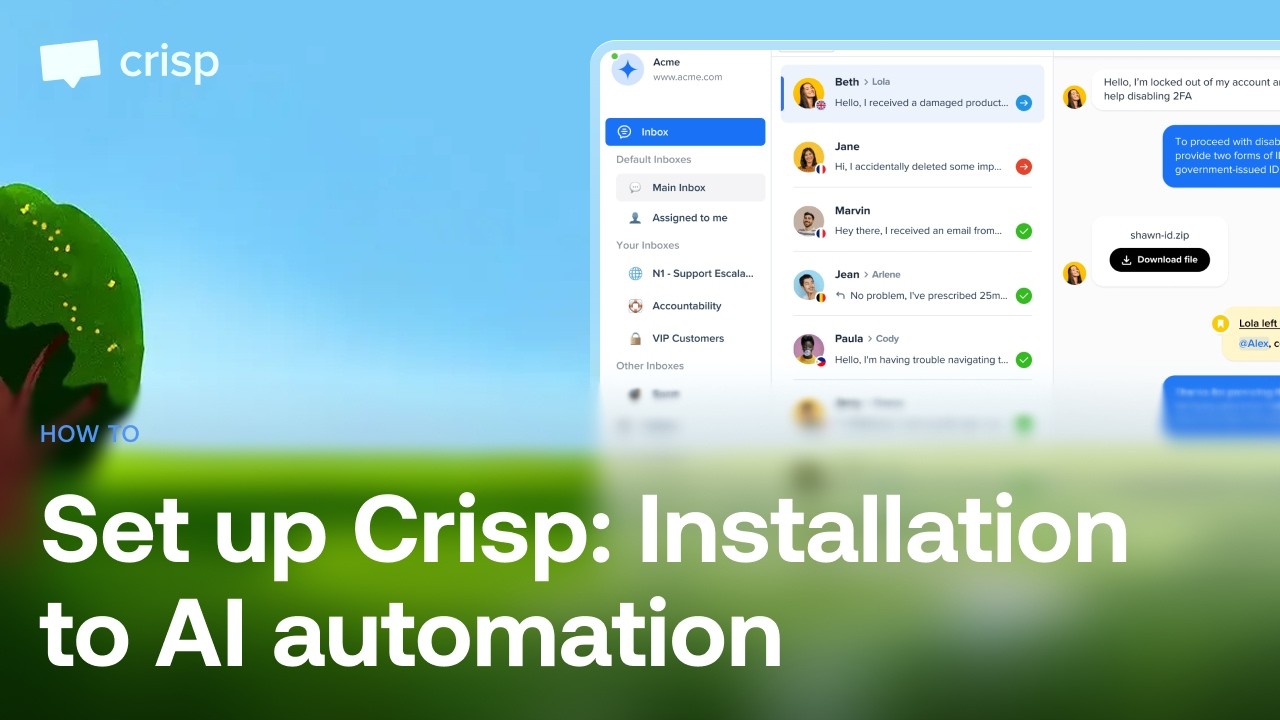
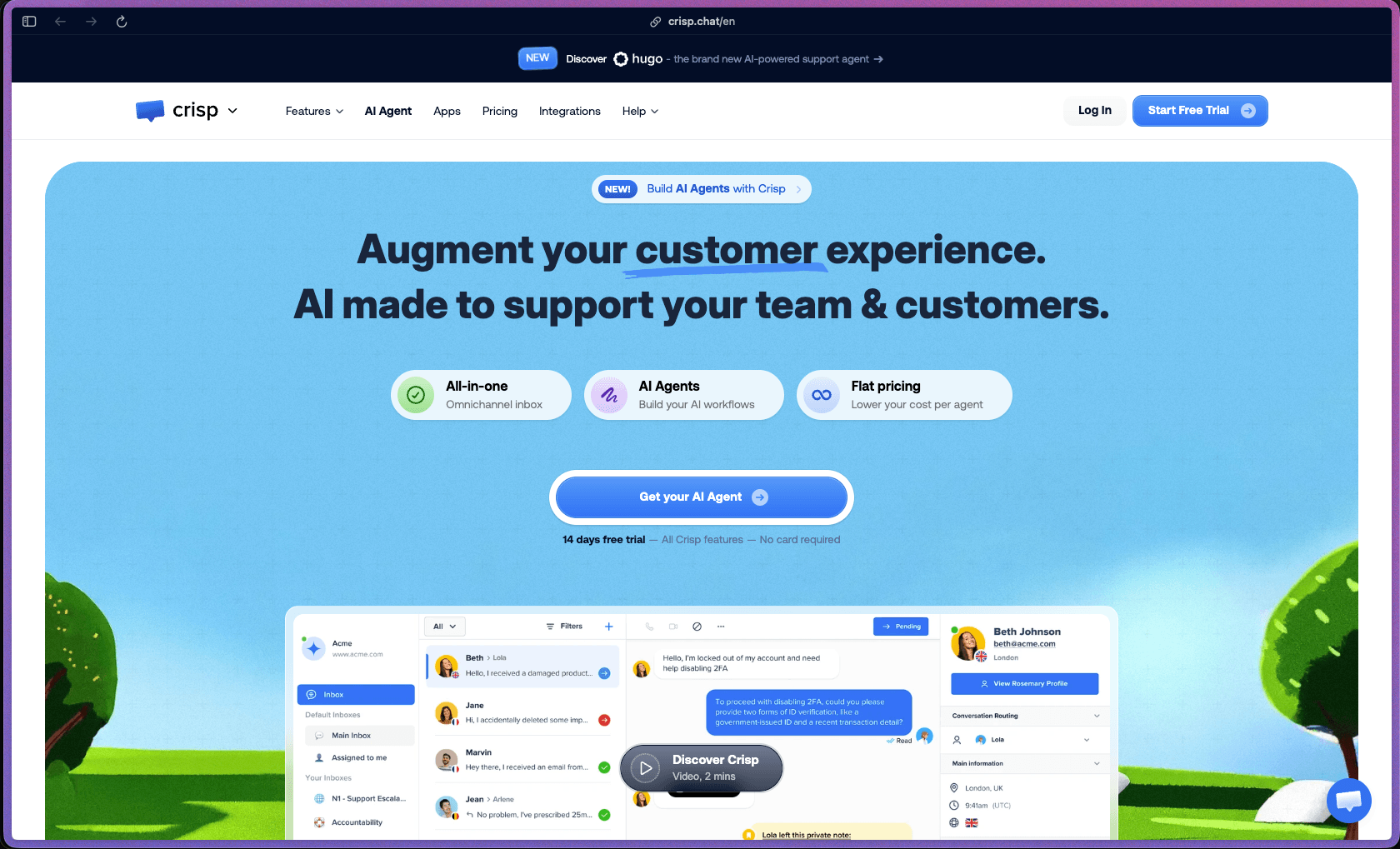
Crisp stands out in the live chat and customer support space because its paid plans are priced per workspace rather than per seat—meaning you can add team members to a shared inbox without the cost scaling the way it does with per-agent competitors like Intercom or Zendesk. It's also one of the few tools at this price point that includes native video and audio calling within the chat widget, which most competitors either omit or charge extra for. Co-founded in 2014 and serving 250 million+ monthly active users across its network, it brings meaningful longevity and scale for a bootstrapped European SaaS product.
Crisp uses a freemium model with a permanent free plan (2 seats) and four paid tiers—Mini, Essentials, Plus, and Enterprise—billed per workspace per month rather than per agent, which makes costs more predictable as your team grows. An Enterprise tier is available at custom pricing for larger organizations with more complex requirements.
Crisp offers a permanent free plan requiring no credit card, which lets you test the core chat widget, shared inbox, and mobile apps with up to 2 seats before committing to a paid plan. A 14-day free trial is included on paid plans, giving access to advanced features before billing begins. Refund policy for paid subscriptions is not prominently specified on the official pricing page—buyers should review Crisp's terms of service or contact support before upgrading to confirm cancellation and billing terms.
Crisp is "mature/established"—co-founded in 2014 by two developers in France, it has been in continuous operation for over 10 years and has grown to serve 250 million+ monthly active users across its customer base, a scale that is consistent with a well-funded and operationally stable product. The platform has evolved from a simple live chat widget to a multi-channel messaging platform with AI features, a chatbot builder, campaign tools, and a knowledge base—each of these additions reflecting sustained and active product investment over time rather than a product that has plateaued. With a team of approximately 20 people managing a platform at this scale, Crisp is a lean European SaaS with a clear bootstrapped character, which may appeal to founders who prefer working with products built by small, focused teams.
- Crisp reports 250 million+ monthly active users across the platform, shared directly by co-founders Baptiste Jamin (CEO) and Valerian Saliou (CTO) in a 2024 public AMA, giving it one of the largest reported reach figures in the independent live chat tools category.
- Trustpilot shows 2.0/5 from 50 reviews with a response time noted as "typically over 1 month," indicating that Trustpilot reviews skew toward dissatisfied users and that support responsiveness is an area of concern for some customers—worth reviewing independently before purchasing.
- Product Hunt reviewer sentiment reflects genuine appreciation for the breadth of features alongside recurring constructive feedback on UI consistency and chatbot/API setup complexity, suggesting strong feature coverage but a steeper learning curve for advanced configurations.
- The Crisp testimonials page features quotes from real company users praising the chat widget size and customizability, the clean mobile experience, and the value relative to more expensive alternatives.
- A 60+ integration library connects Crisp to Shopify, WooCommerce, HubSpot, Salesforce, Slack, Microsoft Teams, WhatsApp, Messenger, Instagram, Telegram, and more—covering most of the platforms that small and mid-size businesses already use.
- A real-time live chat widget installs on any website or web app via a JavaScript snippet and lets your team respond to visitor questions as they happen—with support for file sharing, emoji reactions, audio messages, and visitor chat ratings included in the interface.
- A unified shared inbox consolidates messages from website chat, email, WhatsApp, Facebook Messenger, Instagram, Telegram, and other channels into one view—so your team handles all customer conversations from a single dashboard without switching between apps.
- Native video and audio calling is built directly into the chat widget, allowing support agents to escalate a text conversation to a voice or video call with the customer in the same interface—a feature typically reserved for more expensive platforms or third-party integrations.
- A MagicBrowse feature lets a support agent view what a customer is currently seeing on the website in real time during a live conversation—useful for troubleshooting issues without asking the customer to describe what they see or share screenshots.
- A built-in knowledge base lets you publish self-service help articles that visitors can search directly from within the chat widget before escalating to a live agent, reducing the number of repetitive support conversations your team needs to handle.
- Live chat campaign targeting sends proactive messages to website visitors based on specific behavioral triggers—such as spending a defined amount of time on the pricing page, viewing a specific product, or showing exit intent—rather than waiting for the visitor to initiate contact.
- Email campaigns and broadcast messaging are included on paid tiers, allowing you to send targeted announcements or newsletters to your stored contact base from within the same platform you use for live support—without a separate email marketing tool.
- A customer data platform (CDP) stores visitor and contact information—browsing history, past conversation data, contact attributes, and custom properties—allowing support agents to see a visitor's context before responding, rather than asking for information that's already been captured.
- Over 60 native integrations connect Crisp to the tools businesses already use—including Shopify, WooCommerce, Magento, PrestaShop, HubSpot, Salesforce, Zendesk (for migration), Slack, Microsoft Teams, WhatsApp, Messenger, Instagram, and Telegram.
- An open API and SDK are available for custom integrations and embedding the Crisp chat widget natively into mobile iOS and Android apps or React applications—extending support beyond web-only deployments.
- Slack and Microsoft Teams integrations allow your support team to receive and respond to customer messages directly inside your internal communication tools, without needing to keep the Crisp dashboard open.
- E-commerce platform integrations (Shopify, WooCommerce, Magento, PrestaShop) are available even on the free plan, allowing basic e-commerce customer support features without a paid subscription.
- A chatbot builder with conditional logic lets you create automated conversation flows that handle FAQs, qualify leads, collect contact information, or route conversations to the right team member—running 24/7 across all connected channels without human intervention.
- Automated message triggers send personalized chat messages when visitors perform specific actions—visiting a defined URL, spending a set amount of time on a page, or returning to the site after a prior conversation—allowing targeted outreach without manual monitoring.
- Cart abandonment triggers send automated follow-up messages to e-commerce visitors who add items to their cart and leave without completing a purchase, giving your team or chatbot a prompt to re-engage them at the right moment.
- Shortcut/canned response templates let agents send commonly used reply snippets with a short trigger command, reducing the time spent typing repeated responses to standard questions across multiple open conversations.
- Conversation rating monitoring tracks visitor satisfaction scores (1–5 star ratings submitted after conversations) and stores them in a dedicated reporting view, giving team leads a simple aggregate measure of support quality over time without requiring a separate survey tool.
- A contact data dashboard aggregates stored customer profiles, conversation history, and behavioral data into a CRM-style view, allowing teams to segment contacts by attributes and track how individual customers have interacted with support over time.
- Reporting and analytics on plan dashboards cover conversation volumes, response times, and team activity—though advanced reporting is noted to be more limited than dedicated helpdesk platforms; buyers with complex multi-team reporting requirements should verify current depth before purchasing.
- The chat widget's appearance—colors, position, size, default language, and availability hours—is configurable from the Crisp dashboard without code changes, allowing it to match your site's branding across desktop and mobile.
- Custom email domain support (available on Mini and above) lets outbound support emails send from your own branded domain rather than a Crisp-branded address, maintaining professional brand consistency in all customer-facing email communications.
- A custom status and availability system lets you set online, away, or offline status per agent and configure automatic offline fallback messages or contact form routing so visitors always know how to reach your team even outside support hours.
- Private notes within conversations allow team members to leave internal comments visible only to other agents—useful for handing off conversations, flagging issues for review, or adding context without the customer seeing the internal communication.
- Crisp's AI Data Hub, which stores training data for AI features (knowledge base articles, past conversations, website content, and internal snippets), is described as private and confined to your workspace—AI-generated responses are trained on your own data and not shared across other customer accounts.
- An AI-powered spam filter identifies and quarantines incoming messages flagged as phishing attempts, scams, or malicious content before they reach your main inbox—keeping it clean while still allowing manual review of filtered messages.
- Specific security certifications (SOC 2, ISO 27001, GDPR data processing agreements) are not prominently listed on Crisp's public pricing or features pages; buyers handling sensitive customer data or operating under EU GDPR requirements should request data processing documentation from Crisp's team before activating the platform.
- SaaS startups with 2–10 person teams who want to consolidate website live chat, email support, and customer data into one tool without paying per-agent fees that scale with headcount.
- E-commerce stores on Shopify, WooCommerce, or Magento who need a chat tool that integrates directly with their storefront, supports cart abandonment follow-up, and lets agents see customer order history during live conversations.
- Bootstrapped founders running lean support operations who want a free plan to start and a clear upgrade path to add features as the business grows—without being pushed immediately into a high per-seat pricing structure.
- Digital agencies or freelancers who need a white-label-friendly chat widget deployed across client sites and want a single workspace managing multi-channel customer conversations without juggling separate tools per client.
- Small B2B software companies whose support team needs the ability to escalate live chat conversations to video or audio calls with customers, particularly for onboarding or technical troubleshooting sessions where text alone is insufficient.
- Use it for consolidating customer messaging into one inbox when your team is currently managing website chat in one tool, email in another, and social DMs in a third—and conversations are falling through the gaps between systems.
- Use it for building an automated FAQ chatbot when your support team is repeatedly answering the same 10–20 questions and you want to deflect those conversations to an automated flow before a human agent needs to engage.
- Use it for proactive live engagement on a pricing page when your trial-to-paid conversion rate is low and you want to trigger a targeted message to visitors who spend more than a defined amount of time on pricing without starting a conversation.
- Use it for setting up a knowledge base with in-widget search when you want visitors to self-serve answers before contacting support—reducing incoming ticket volume without building a separate documentation site.
- Use it for managing post-sale customer support with video escalation when you need to support customers through complex technical issues or product onboarding that text-based chat alone doesn't handle efficiently.
- Use it for cart abandonment recovery on an e-commerce site when visitors are adding items but not completing checkout and you want automated follow-up chat messages to re-engage them with or without a discount offer.
- Cloud-hosted SaaS platform accessed via a web browser dashboard—no server installation required; the chat widget is deployed via a JavaScript snippet that works on any website platform.
- Native iOS and Android mobile apps are included on all plans (including free), allowing support agents to respond to customer conversations on mobile without accessing the web dashboard.
- SDKs are available for embedding the Crisp chat widget natively in iOS, Android, and React Native mobile applications—extending in-app support beyond web-only deployments.
- A WordPress plugin is available for one-click Crisp widget installation on WordPress sites without manually editing theme files.
- 60+ native integrations include Shopify, WooCommerce, Magento, PrestaShop, HubSpot, Salesforce, Slack, Microsoft Teams, WhatsApp, Messenger, Instagram, Telegram, and Zapier for extended automation connections.
- An open API allows custom integrations and the ability to embed Crisp capabilities into proprietary internal tools or workflows for engineering teams needing deeper custom connectivity.
Crisp's most direct differentiation from tools like Intercom and HubSpot Chat is its per-workspace pricing model—you pay a flat monthly rate for the whole workspace rather than multiplying costs per agent seat, which makes it substantially more affordable for growing teams where those tools become expensive quickly. Compared to simpler free alternatives like Tidio or Tawk.to, Crisp offers a significantly broader feature set—including native video calling, an AI chatbot builder, email campaigns, and a knowledge base—within a single subscription that doesn't require multiple third-party add-ons to match those capabilities. It works particularly well for teams that want multichannel support (chat, email, social, SMS) in one place without enterprise pricing, though teams with very complex chatbot or reporting needs may eventually find the configuration depth of dedicated helpdesk platforms more suitable.
- Crisp's Trustpilot rating of 2.0/5 with a noted typical response time of over 1 month for support interactions is a meaningful caution flag—buyers who require consistently responsive customer support for a business-critical chat tool should review this signal carefully and test support responsiveness during the free trial period before committing.
- A comprehensive official knowledge base (help.crisp.chat) covers onboarding, plan features, chatbot configuration, API documentation, AI feature setup, integrations, and billing—and is actively maintained with recent publication dates in 2025–2026, suggesting the self-service documentation is well-resourced even if direct support response times are a concern.
- No dedicated community forum, Discord, or public Slack group is prominently listed; primary peer support comes from a reasonable volume of third-party tutorials, review content, and the Reddit and Indie Hackers communities where Crisp's co-founders have been directly active in public discussions.
- Trustpilot reviewers and Product Hunt feedback both note that the chatbot builder and API/plugin setup can be complex for non-technical users—teams without developer support may find advanced chatbot flows and integrations require significant time investment to configure correctly.
- The free plan is limited to 2 seats, 100 stored user profiles, and no chatbot, automation, or campaign features—making it suitable only for very early-stage testing rather than as a long-term free tier for growing teams.
- AI features (Copilot, Magic Reply, AI chatbot, topic tagging, conversation summaries, and advanced AI training) are gated behind the Essentials and Plus tiers—teams on the Mini plan or free plan do not have access to any AI-powered support capabilities.
- Trustpilot support feedback indicates slow direct support response times (noted as typically over one month), which is a material concern for businesses relying on the tool as a critical customer-facing channel where platform issues need timely resolution.
Related Products
Recently Added!
Wrike
Recently Added!
TimeDoctor

Recently Added!
RingCentral

Recently Added!
Retable

Recently Added!
Parallels Desktop

Recently Added!
Pabbly Connect

Recently Added!
Nuelink

Recently Added!
Kit (formerly ConvertKit)
Recently Added!
Intercom
Products With Lifetime Deals
Recently Added!
FluentForms
Recently Added!
Divi Theme
Recently Added!
ConvertPro
Recently Added!
CartFlows
Recently Added!
Bullet Proof Security
Recently Added!
WP Booking Calendar
Recently Added!
BeaverBuilder
Recently Added!
Avada
Recently Added!
Independent Analytics
You Recently Viewed These
Recently Viewed
BitFlows

Recently Viewed
Amelia
Recently Viewed
Dynamic.ooo

Recently Viewed
Microthemer & Amender

Recently Viewed
LifterLMS

Recently Viewed
Masteriyo

Recently Viewed
Zynith SEO
Recently Viewed
Wrike
Recently Viewed
WPMU Dev
Recently Viewed
wpDataTables
Recently Viewed
WP Booking Calendar
Recently Viewed
Webflow