Constant Contact
Constant Contact

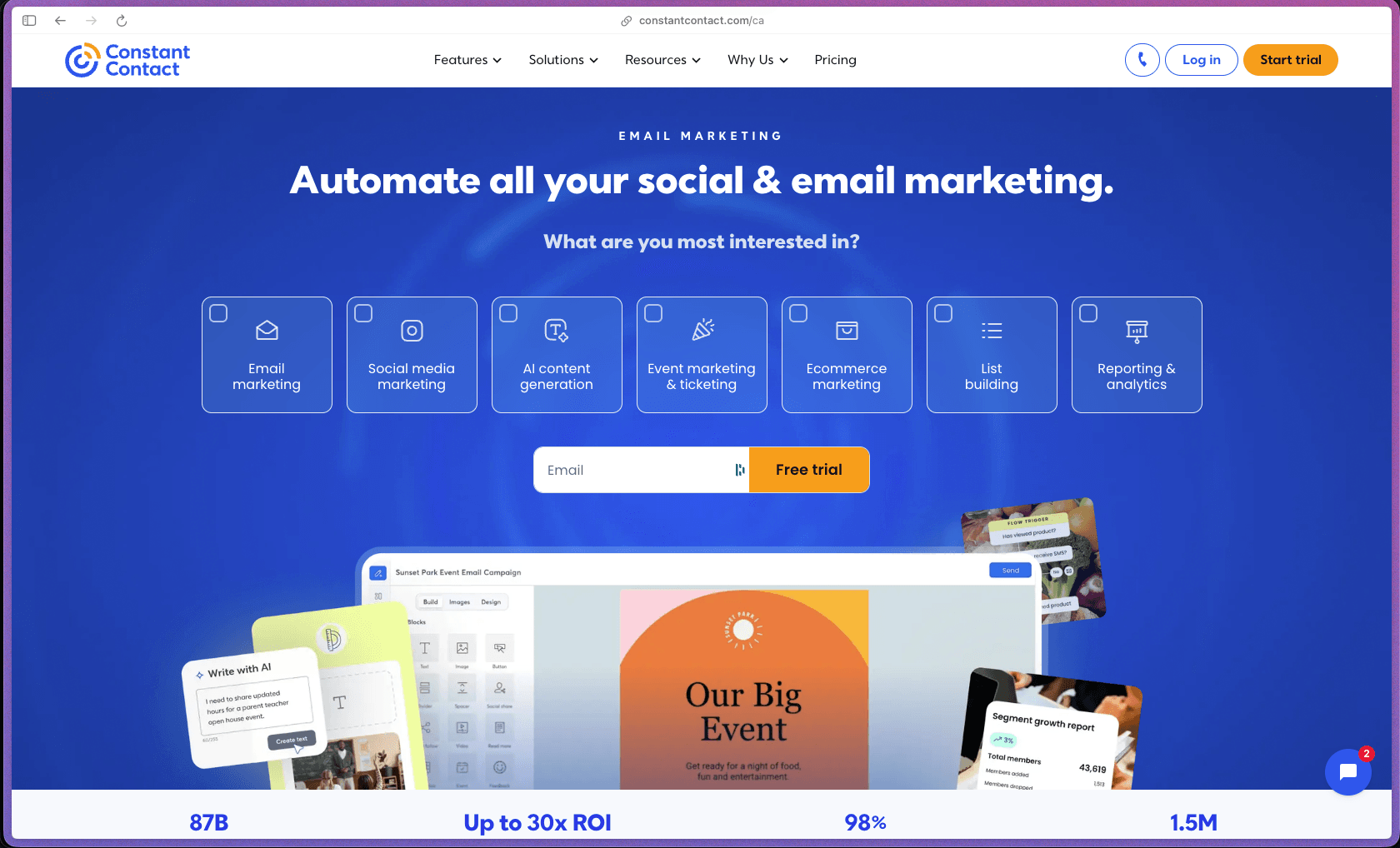
Constant Contact has been a fixture in small business email marketing since 1995—one of the longest-running platforms in the category—and that history shows in the breadth of its template library, deliverability infrastructure, and support resources. What sets it apart from comparably priced tools is the addition of event management features (ticket sales, RSVPs, registration forms) and an in-platform social posting and ads manager, making it a more complete marketing toolkit for organizations running regular events or community programs. It's a particularly practical fit for nonprofits, local service businesses, and retail shops that need a reliable, low-friction tool that doesn't require a dedicated marketing background to use.
Constant Contact uses a monthly subscription model with three paid tiers (Lite, Standard, Premium), priced by the number of contacts on your list—there is no permanent free plan, though a free trial is available. Annual billing is offered as an alternative to monthly billing; pricing scales as contact list size grows beyond the base tier threshold.
Constant Contact offers a 60-day free trial for new users, which is longer than most email marketing platforms; no credit card is required to start. Refund policy details for paid plan subscriptions are not prominently specified on the official site—buyers should review Constant Contact's terms of service or contact support to confirm cancellation and billing terms before upgrading.
Constant Contact is "mature/established"—founded in 1995 and continuously operating for over 30 years, it is one of the oldest email marketing platforms available and has maintained an active, paying customer base through multiple generations of the market. The platform has undergone several feature expansions in recent years, adding AI-assisted content writing, SMS marketing (US only), expanded automation capabilities, Google/Facebook/Instagram ads management, and an event ticketing system—demonstrating active investment in keeping the product relevant alongside newer competitors. Constant Contact is owned by Endurance International Group (now Newfold Digital) and operates as a standalone product line with a large support organization, established documentation, and a publicly active community forum.
- Rated 4.2 out of 5 on G2 from 9,100+ verified reviews as of June 2026, one of the largest review datasets of any email marketing tool on the platform.
- Rated 4.3 out of 5 on Capterra, and 4 out of 5 on Trustpilot from 1,700+ reviews—with reviewers consistently highlighting ease of use, template quality, and customer support responsiveness.
- Constant Contact has been operating since 1995 and is used by hundreds of thousands of small businesses and nonprofits globally, with a proprietary dataset drawn from 2.1 million+ customer email campaigns cited in published research.
- G2 reviewers rank Constant Contact as a leader in customer support quality, with the support team's responsiveness specifically cited as a differentiator over competing email tools.
- G2's review base skews toward small businesses under 50 employees and nonprofits—indicating the platform's actual user base aligns closely with its intended audience.
- A drag-and-drop email builder with 200+ professionally designed templates lets non-designers create formatted, mobile-responsive emails without coding or design skills.
- Contact list management tools let you import, store, and organize subscriber lists, with segmentation options based on engagement behavior, location, purchase history (via Shopify/Etsy sync), and custom fields.
- Email deliverability infrastructure is one of Constant Contact's established strengths—third-party review sources cite a 97% deliverability rate, meaning emails are reliably reaching inboxes rather than spam folders.
- Event management lets you create event pages, send invitations, manage registrations, sell and generate printable tickets, accept payments via PayPal or Stripe, and create promotional codes for early-bird or discount registrations—all without a separate event platform.
- SMS marketing (available in the US on the Premium plan) lets you send up to 500 text messages per month to subscribers alongside your email campaigns, adding a direct mobile channel.
- A/B split testing on subject lines lets you test two subject line variations against a portion of your list and automatically send the better-performing version to the rest—available on Standard and above.
- Email resend to non-openers automatically resends a campaign with an alternative subject line to contacts who didn't open the first version, increasing reach without manually recreating the send.
- Landing pages with unique URLs let you build standalone sign-up pages for lead capture that aren't dependent on your main website.
- Surveys, polls, and coupons can be embedded directly into email campaigns to drive engagement or collect feedback without third-party tools.
- Social media posting lets you draft, schedule, and publish posts to Facebook, Instagram, LinkedIn, and other platforms from within Constant Contact—keeping email and social content in the same workflow.
- Paid social advertising integration lets you create and manage Facebook, Instagram, and Google Ads directly inside Constant Contact, with contact list syncing for audience targeting.
- AI writing assistant helps generate subject line suggestions and email body copy from short prompts, reducing the time required to write campaign content from scratch.
- A mobile app lets you manage your account, send campaigns, and check results from a smartphone.
- Shopify, Etsy, and eBay integrations sync product and purchase data into Constant Contact so you can segment contacts by buying behavior and send targeted campaigns based on purchase activity.
- Salesforce integration syncs contact and sales data between Constant Contact and Salesforce CRM for teams managing marketing alongside a sales pipeline.
- 300+ app integrations are available across the ecosystem, covering CRMs, e-commerce platforms, event tools, and accounting software—Zapier is supported for connecting with tools not in the native integration library.
- QuickBooks and WooCommerce integrations are among the supported e-commerce and accounting connections that allow contact data and purchase records to flow between platforms.
- WordPress plugin and website builder integrations allow sign-up form embedding directly on WordPress sites to grow subscriber lists without manual export/import.
- Welcome series automation sends a pre-configured sequence of emails to new subscribers automatically—this is included on the Lite plan and is the most accessible entry-point automation for teams just getting started.
- Behavior-based automation triggers emails based on contact actions—a click in a previous email, a purchase on a connected store, or a contact joining a specific list—allowing follow-up sequences without manual monitoring.
- Standard plan includes three automation flows; Premium removes the limit entirely, allowing teams to build multiple branching sequences for different audience segments.
- Automated birthday and anniversary email series let businesses send personalized messages on contact milestone dates without manually scheduling each one.
- Contact tagging and automatic list updates keep your segments current as subscriber behavior changes, without requiring manual list management.
- Real-time campaign analytics show open rates, click-through rates, bounces, unsubscribes, and spam reports per campaign immediately after sending, allowing teams to assess performance without waiting for a daily summary.
- Click tracking maps show exactly which links in an email received clicks, helping teams understand which content or CTAs drive the most engagement in each campaign.
- Advanced reporting on Standard and Premium plans includes comparison reporting across multiple campaigns and deeper engagement analytics beyond the basic per-send view.
- Contact engagement scoring tracks individual subscriber activity over time, enabling teams to identify and segment highly engaged contacts separately from lapsed subscribers.
- Social media engagement analytics (reach, clicks, engagement per post) are viewable alongside email metrics in the same dashboard for teams managing both channels.
- Custom branded email templates can be saved and reused across campaigns, keeping visual consistency without rebuilding the layout each time.
- Custom sign-up form fields allow teams to collect specific subscriber information beyond just name and email at the point of list entry.
- Custom segments on the Premium plan allow unlimited audience groupings built from any combination of contact attributes, behaviors, or purchase data.
- Event registration forms can be customized with the fields relevant to a specific event type—workshops, product launches, ticketed dinners—without a fixed form structure.
- CAN-SPAM and GDPR compliance tools are built into the platform, including automatic unsubscribe handling, required physical address inclusion in emails, and consent management for contact lists.
- Two-factor authentication (2FA) is available for account login to prevent unauthorized access.
- Contact data is stored on Constant Contact's cloud infrastructure, which maintains SOC 2 compliance as a baseline data security standard for a SaaS platform of this scale. Not specified beyond general enterprise practices on the official public site.
- Bounce and spam complaint management is automated—hard bounces are removed from active lists and repeat spam complaints flag accounts for review, protecting sender reputation and deliverability.
- Local service businesses (salons, fitness studios, restaurants, real estate agents) that send regular newsletters or promotions and need a straightforward, reliable tool without a learning curve.
- Nonprofits and community organizations that run events, fundraising drives, and regular donor communications and want email, event ticketing, and social posting in one place without separate subscriptions.
- Retailers and e-commerce stores on Shopify or Etsy that want to sync purchase data and send targeted email sequences to different buyer segments without switching between platforms.
- Small marketing teams and solo entrepreneurs who are new to email marketing and need pre-built templates, a guided onboarding experience, and accessible phone and chat support when they get stuck.
- Event organizers and workshop hosts who run ticketed or registration-based events and want to manage invitations, RSVPs, ticket sales, and follow-up emails from a single marketing tool.
- Use it for running a monthly newsletter campaign when you have a contact list of customers or community members and want reliable deliverability and a clean template without building emails from scratch.
- Use it for selling and managing event registrations when you run workshops, classes, or store events and want to handle invitations, ticket sales, and post-event follow-up without a separate event platform.
- Use it for building a welcome email series for new subscribers when you want every new contact to receive a consistent, automated introduction to your business without manually sending individual emails.
- Use it for retargeting lapsed customers with an automated re-engagement sequence when your list has grown and you want to identify and reach out to subscribers who haven't opened your emails in 90+ days.
- Use it for syncing Shopify purchase data to email segments when you want to send different campaigns to first-time buyers vs. repeat customers vs. high-value customers without manually exporting data.
- Use it for managing social posts and email from a single dashboard when you're running a campaign across both channels and don't want to context-switch between separate tools to schedule content.
- Cloud-hosted SaaS platform accessible via a web browser and a native mobile app for iOS and Android—no installation required.
- Native integrations with Shopify, Etsy, eBay, Salesforce, WooCommerce, QuickBooks, Eventbrite, and 300+ additional apps.
- Zapier integration extends connectivity to tools not covered by native integrations.
- A WordPress plugin is available to embed sign-up forms on WordPress sites.
- SMS marketing is currently available to US-based accounts only on the Premium plan.
- Google Ads, Facebook Ads, and Instagram Ads management is available as a native integration inside the platform on Standard and Premium plans.
Constant Contact competes directly with Mailchimp, Brevo (formerly Sendinblue), and ActiveCampaign in the small business email marketing segment—but distinguishes itself with built-in event management (ticketing, registrations, check-in) and a longer-tenured support organization, both of which are uncommon in comparably priced email tools. Compared to Mailchimp, G2 reviewers consistently rate Constant Contact's customer support higher, while Mailchimp's free plan accommodates budget-constrained users that Constant Contact's paid-only model doesn't serve. For teams that primarily need email automation depth or CRM-like behavior tracking, tools like ActiveCampaign or Klaviyo go further—Constant Contact's strength is breadth and accessibility, not advanced automation sophistication.
- Phone, live chat, and email support are available to all paid plan customers; this is a notable differentiator in the email marketing category where many competitors offer live chat or email only—G2 reviewers consistently cite Constant Contact's support quality and responsiveness as above average.
- An extensive knowledge base and help center at knowledgebase.constantcontact.com covers email creation, list management, automation setup, integrations, and account billing with step-by-step articles and video tutorials.
- A community forum, professional services team (for outsourced email campaign management), and a library of small business marketing guides and blog content extend support options beyond technical assistance.
- There is no free plan—only a 60-day trial—meaning teams on tight budgets who need a permanently free tier will find Mailchimp or Brevo's free options more accessible for low-volume sending.
- Pricing scales with contact list size, and costs can become expensive for larger lists, with some G2 reviewers and independent pricing analysis noting that Constant Contact's per-contact cost is higher than several competitors at equivalent contact thresholds.
- SMS marketing is only available to US-based accounts on the Premium plan—non-US teams or teams on Lite/Standard plans have no SMS channel access.
- Automation capabilities, while improved, are considered less sophisticated than dedicated automation-focused tools—the Standard plan limits automation to three flows, and even the Premium plan's unlimited flows lack the conditional branching depth found in tools like ActiveCampaign or Klaviyo.
Related Products
Recently Added!
Wrike
Recently Added!
TimeDoctor

Recently Added!
RingCentral

Recently Added!
Retable

Recently Added!
Parallels Desktop

Recently Added!
Pabbly Connect

Recently Added!
Nuelink

Recently Added!
Kit (formerly ConvertKit)
Recently Added!
Intercom
Products With Lifetime Deals
Recently Added!
FluentForms
Recently Added!
Divi Theme
Recently Added!
ConvertPro
Recently Added!
CartFlows
Recently Added!
Bullet Proof Security
Recently Added!
WP Booking Calendar
Recently Added!
BeaverBuilder
Recently Added!
Avada
Recently Added!
Independent Analytics
You Recently Viewed These
Recently Viewed
BitFlows

Recently Viewed
Amelia
Recently Viewed
Dynamic.ooo

Recently Viewed
Microthemer & Amender

Recently Viewed
LifterLMS

Recently Viewed
Masteriyo

Recently Viewed
Zynith SEO
Recently Viewed
Wrike
Recently Viewed
WPMU Dev
Recently Viewed
wpDataTables
Recently Viewed
WP Booking Calendar
Recently Viewed
Webflow