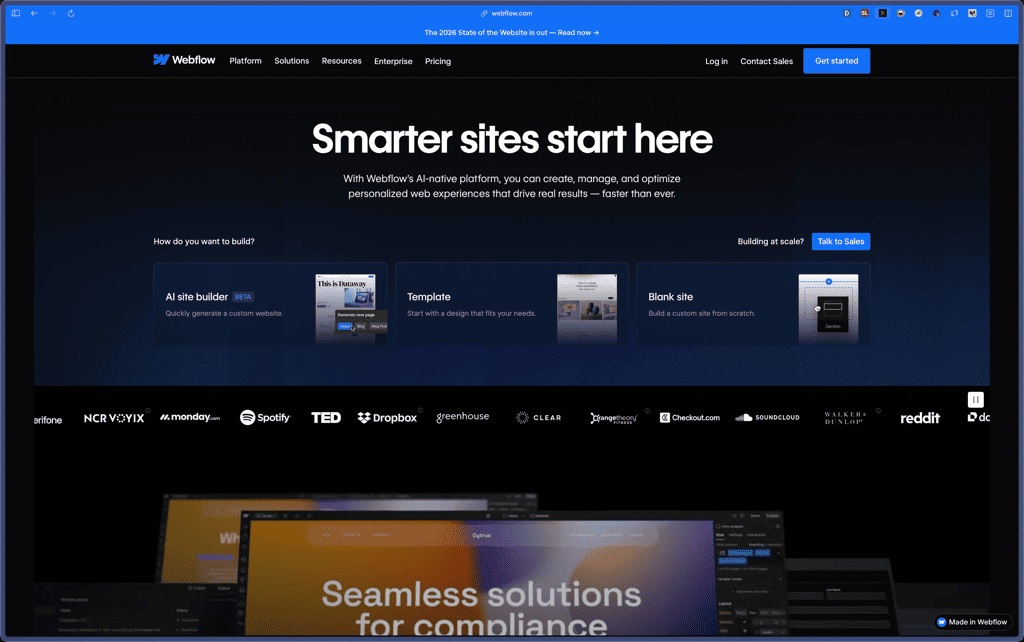
Frase
Frase

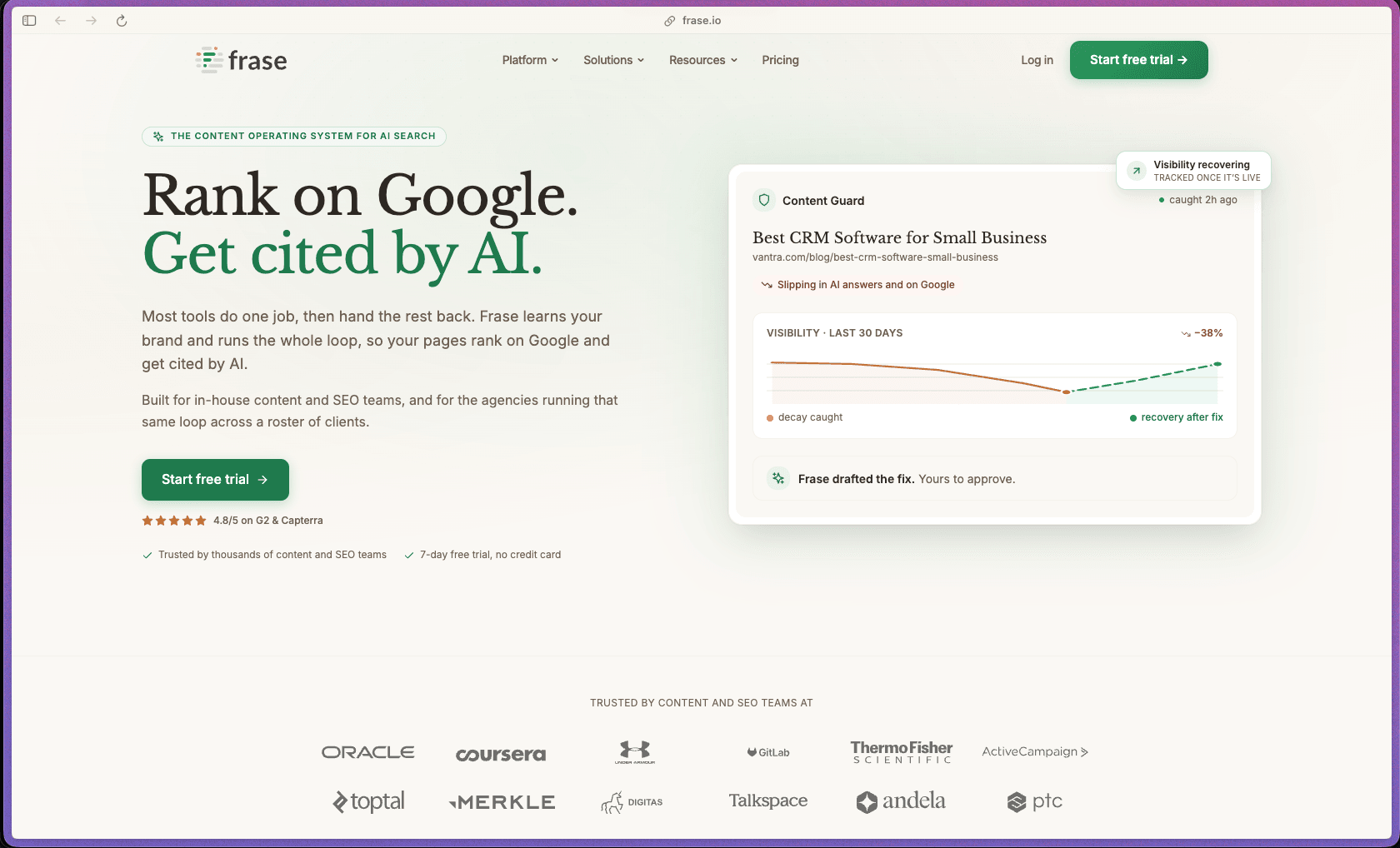
Frase sits at the practical intersection of content research and content optimization—rather than being purely an AI writer or purely an SEO audit tool, it connects SERP analysis, competitor content data, and real-time optimization scoring inside a single editor where you're also drafting the article. Case studies from legal marketing agency Hennessey Digital, healthcare provider PTSMC, and digital agency V Digital Services document concrete outcomes including 180 hours/month saved and 4x content output increases—providing measurable third-party evidence of real-world productivity impact. With a 4.8/5 rating across both G2 and Capterra from 500+ combined reviews and 8,000+ customers acquired in a single AppSumo launch—its scale as an established tool in an otherwise fast-moving, fragmented category is well-evidenced.
Frase uses a monthly subscription model with tiered plans differentiated by the number of documents, users, and feature access—including a Solo plan for individual users and higher tiers for growing content teams and agencies. No permanently free tier is available, but a 5-day trial is offered at a significantly reduced entry cost to allow short-term evaluation before committing to a full monthly plan.
Frase offers a 5-day trial at a low introductory entry cost—allowing meaningful evaluation of the platform's core research, brief creation, and optimization workflow before committing to a standard monthly plan. A specific money-back guarantee period beyond the trial is not prominently stated on the official pricing page—buyers should review the current refund policy at frase.io/pricing before purchasing.
Frase is "growing/stable" trending toward "mature/established"—founded around 2018 and with a documented Frase blog dating to 2019, the platform has approximately 7–8 years of continuous development, placing it well past the early-adopter phase for an AI-native content tool in a category that has seen significant new entrants since 2022. The February 2026 platform overhaul ("The New Frase") introduced an AI Agent, programmatic SEO capabilities, and complete content workflow redesign—indicating substantial ongoing engineering investment rather than feature maintenance alone. G2's 296+ reviews and Capterra's verified review base, combined with 40+ published client case studies from named companies across legal, healthcare, e-commerce, and agency verticals, provide the depth of evidence expected from an established B2B SaaS product rather than a newer market entrant.
- Rated 4.8 out of 5 on both G2 and Capterra from a combined 500+ reviews—as stated on the official Frase homepage—with G2 carrying 296+ verified reviews specifically.
- G2 reviewers consistently cite SERP analysis speed, brief generation quality, and content scoring accuracy as the most frequently praised strengths across reviews—with multiple reviewers describing it as a daily-use tool for content teams.
- Frase generated nearly $800K in revenue and added 8,000+ customers during a single AppSumo campaign—documented in the Frase blog as the largest AppSumo launch at the time it occurred—indicating strong initial market validation beyond organic growth.
- Published case studies (40+) on the Frase website include named clients: Hennessey Digital (legal marketing agency), V Digital Services (multi-client SEO agency), PTSMC (healthcare provider), Opinion Stage, Embryo Digital (180 hours/month saved, 4x content output), and Red 11 Media—providing documented real-world outcomes from multiple industry verticals.
- Independent reviews from RankPilot (2026), TheStacc (2026), SoftwareBlip (2025), and RankPilot collectively provide current third-party coverage with feature testing and pricing breakdowns—confirming active press coverage through mid-2026.
- The Frase MCP (Model Context Protocol) integration for Claude AI is referenced in a homepage testimonial—indicating the platform has extended into the AI agent and LLM integration ecosystem beyond a standalone browser-based tool.
- SERP analysis for any target keyword pulls the top-ranking Google results and extracts their title tags, meta descriptions, heading structures, content length, word count benchmarks, and semantic topic coverage—giving you a data-driven picture of what's working in the top 10 before you write a single sentence.
- NLP-powered topic extraction uses natural language processing to identify the themes, entities, and questions that Google prioritizes across the top-ranking pages for your keyword—going beyond keyword matching to surface the underlying intent structure that high-ranking content addresses.
- Content brief generation compiles competitor data, recommended heading structures, topic clusters to cover, People Also Ask questions, keyword density guidance, and content length targets into a structured brief—ready to send to a writer or use as a drafting scaffold directly in the Frase editor.
- AI writing assistant drafts blog introductions, paragraphs, FAQ sections, outlines, and full article sections using AI generation with configurable templates—operating within the same editor where your brief and SERP data are already loaded, so you don't switch between a separate AI writing tool and your research.
- Real-time content optimization scoring grades your draft against the top-ranking competitors as you write—displaying a 0–100 topic coverage score, a list of missing semantic keywords, recommended keyword frequency targets, and heading optimization suggestions that update live as you add and revise content.
- Brand voice and terminology governance (Frase AI Agent) allows teams to define preferred terminology, banned phrases, tone parameters, and brand style guidelines within the platform—ensuring AI-generated and AI-assisted content conforms to the company's established voice across all writers and documents.
- Programmatic SEO tooling (introduced in the 2026 platform update) enables teams to generate and optimize large batches of pages targeting long-tail keyword clusters—scaling structured content production to hundreds of pages from template-based workflows without manually briefing each page individually.
- Document organization and workspace management lets teams organize all research, brief, and draft documents within Frase—with folder structures, document search, and multi-user access—serving as a centralized content operations hub rather than storing documents in separate Google Docs or Notion pages.
- AI search (GEO/AEO) optimization for LLM visibility helps content teams optimize articles not just for Google SERP rankings but for citations and surfacing in AI-generated answers from ChatGPT, Perplexity, Claude, and similar AI search tools—addressing the emerging "generative engine optimization" (GEO) need that traditional SEO tools don't cover.
- Content monitoring and fix workflow tracks published content performance over time and surfaces pages that have dropped in ranking, lost AI citation visibility, or need optimization updates—closing the loop between initial content creation and ongoing content maintenance without a separate monitoring tool.
- Content publishing integration allows completed documents to be published externally from within the Frase workspace—reducing the final step of copying and pasting content from the editor into a CMS or external publishing tool.
- Collaborative editing allows multiple team members to access and work on documents simultaneously within the Frase workspace—supporting content teams where a strategist, writer, and SEO editor all touch the same document at different stages of the production workflow.
- WordPress integration allows content drafted and optimized in Frase to be published directly to a connected WordPress site—eliminating the manual copy-paste step of moving a finalized article from the Frase editor into the WordPress block editor.
- Frase MCP (Model Context Protocol) integration connects the Frase platform to Claude AI as an agent tool—allowing Claude to call Frase's SERP research and content audit capabilities directly within a Claude conversation, extending Frase's research data into LLM-based workflows.
- Google Search Console integration pulls search performance data (impressions, clicks, CTR, average position) from your connected GSC property into Frase—allowing content optimization decisions to be informed by actual traffic and ranking data from your own site rather than only competitor SERP snapshots.
- Zapier integration connects Frase document and workflow events to the broader Zapier automation ecosystem—enabling connection to project management tools, CRMs, Slack notifications, and other platforms not directly integrated with Frase.
- API access allows developers to integrate Frase's SERP research and content optimization data into custom workflows, internal tooling, and content management systems—documented for teams that need to connect Frase data to proprietary publishing or reporting infrastructure.
- Automated content brief generation creates a structured brief from a keyword input in seconds—pulling competitor heading structures, PAA questions, topic recommendations, and word count targets automatically without requiring manual SERP review for each new content project.
- AI-generated first drafts reduce the blank-page writing time for standard content formats (blog posts, listicles, FAQ pages, how-to guides) by generating a structured draft from the brief data—which writers then edit and optimize rather than creating entirely from scratch.
- Programmatic page generation (scale workflows) automates the creation of large volumes of structured, keyword-optimized pages from template inputs—covering use cases like location pages, product category pages, FAQ databases, and long-tail keyword clusters that would be impractical to produce manually.
- Content performance monitoring runs automatically on connected published pages—flagging content that has slipped in rankings or lost AI citation appearances so content teams can prioritize update work based on actual performance signals rather than guessing which articles need attention.
- Content scoring dashboard displays real-time optimization scores (0–100) for every active document—giving content managers a visual overview of which articles in production are well-optimized and which need additional topic coverage before publication.
- Google Search Console data integration surfaces click, impression, CTR, and ranking position data per page within the Frase interface—enabling content teams to prioritize optimization work on pages with high impressions but low CTR or pages with rankings in positions 5–15 that are close to the first-position traffic tier.
- Competitor content analysis reports show side-by-side comparisons of word count, topic coverage, heading structure, and semantic keyword density between your draft and each top-ranking competitor—allowing writers to see specifically where gaps exist rather than receiving only an aggregate score.
- AI search visibility monitoring tracks which of your published pages are being cited or surfaced in LLM-generated AI answers—providing visibility into GEO/AEO performance as a complement to traditional SERP rank tracking.
- Custom AI templates allow teams to define their own writing templates for recurring content formats—specifying the structure, tone, word count, and output style of AI-generated sections so the output aligns with the brand's established content format rather than a generic article template.
- Brand voice and terminology settings define preferred language, restricted terms, required style guidelines, and tone parameters at the account level—applied automatically across AI-generated content for all team members using the workspace.
- User roles and access management allow content teams to assign different permission levels to team members—separating writer access (document editing) from manager access (workspace settings, integrations, billing)—with support for multi-seat team plans and guest/collaborator access for external contributors.
- Document folder organization and tagging let teams structure their Frase workspace by client, topic cluster, content type, or publication schedule—providing a content operations infrastructure for agencies and larger teams managing dozens of active documents simultaneously.
- Frase is a cloud-hosted SaaS platform—all documents, SERP data, and content are stored on Frase's own servers rather than locally; buyers handling sensitive client data or content under NDA should review Frase's data processing policies and terms of service, which are not summarized prominently on the main product or features pages.
- User role and access controls restrict workspace access based on assigned permissions—preventing writers from accessing billing, integration settings, or team management functions, and allowing external collaborators to be added with limited document access rather than full account access.
- No specific SOC 2 compliance, GDPR data processing agreement, or enterprise security certification is prominently advertised on the frase.io website for standard plans—buyers at organizations with formal security compliance requirements should contact Frase directly to request data processing documentation before committing to a plan.
- SEO agencies managing content production for 5–20+ clients simultaneously who need a system for scaling brief creation, assigning optimized outlines to freelance writers, reviewing optimization scores before delivery, and tracking post-publish ranking performance—all without switching between multiple research, writing, and reporting tools.
- In-house content marketing teams at SaaS companies or B2B services who publish 4–20+ articles per month and want to standardize their content research and brief workflow—ensuring every piece of content addresses the right topics, questions, and semantic coverage before it enters the writing stage.
- Solo SEO consultants and content strategists who produce content for clients and need to compress the research-to-brief phase from hours to minutes—using Frase's SERP analysis and brief generation to spend more time on strategy and editing rather than manual competitor review for each keyword.
- Legal, healthcare, and professional services firms with in-house marketing teams who want to build topical authority through consistent, well-researched long-form content—using Frase's AI writing assistance and content scoring to maintain editorial quality at a pace that a small internal team can sustain without hiring additional writers.
- Content teams actively managing AI search visibility (GEO/AEO) who need a tool that monitors not just Google SERP rankings but also whether their published content is being cited in ChatGPT, Perplexity, and Claude AI answers—a use case not covered by traditional rank tracking tools.
- Use it for building research-backed content briefs at scale when you produce multiple articles per week and want each brief to include competitor heading structures, People Also Ask questions, topic coverage requirements, and word count targets generated automatically from a keyword input.
- Use it for optimizing existing published content when you have articles ranking on page 2 or below position 5 and want to identify the specific missing topics, semantic keywords, and heading gaps that prevent them from competing with the current top-ranking pages.
- Use it for managing a distributed content team when you have in-house writers, freelancers, and an SEO manager all working on the same content program and need a shared workspace where briefs, drafts, optimization scores, and revision history are visible to everyone without email chains or shared Google Docs.
- Use it for programmatic SEO page creation when you need to build and optimize a large volume of location pages, product category pages, or long-tail FAQ content and want to generate structured, keyword-optimized templates at scale rather than manually briefing each page.
- Use it for monitoring AI search citation visibility when you want to track which of your published pages are being surfaced in AI-generated answers from major LLMs—and identify content that needs updating to maintain or improve its presence in AI search results alongside traditional SERP rankings.
- Use it for cutting first-draft production time when you want writers to receive a fully structured brief with an AI-generated draft scaffold—allowing them to edit and refine rather than write from scratch, which Embryo Digital documented as saving 180 hours per month across their content operation.
- SaaS web application—fully cloud-hosted, accessible via any modern web browser on Mac, Windows, or Linux with no software installation required; all documents, SERP data, and workspace settings are stored in Frase's cloud infrastructure.
- No self-hosted or on-premise version is available—all data processing and storage occurs within Frase's own hosted environment.
- Native integrations: WordPress (direct publish), Google Search Console (ranking and traffic data pull), Zapier (workflow automation bridge), and Frase MCP for Claude AI (agent-level integration for LLM-based workflows).
- REST API access is available for custom integrations—documented for teams that need to connect Frase research data, document content, or scoring outputs to custom internal tools, CMS platforms, or reporting systems.
- AI writing capabilities are powered by large language models (specific model providers not disclosed on the public-facing features or pricing pages); AI generation operates within the Frase editor rather than requiring a separate OpenAI or Anthropic API key from the user.
- Chrome extension is available for accessing Frase features within the browser without navigating to the Frase web app—supporting in-browser SERP research and brief access during content research sessions.
Frase's most direct competitors in the AI SEO content tool category are Surfer SEO, Clearscope, and MarketMuse—all focusing on content optimization scoring against SERP competitors. Frase's positioning difference is that it covers a broader workflow span than pure optimization tools—starting from SERP research and brief creation rather than beginning with a draft already written—while also extending toward GEO/AEO monitoring for AI search citation visibility, which most established SEO content tools have not yet fully addressed. Compared to Surfer SEO (which many reviewers use alongside Frase for its deeper keyword research and on-page scoring), Frase is positioned as the research-to-brief phase tool while Surfer tends to be used for post-draft SEO scoring—meaning the two tools are sometimes used together rather than being purely interchangeable substitutes.
- Support is available via in-app chat and email; no public SLA or first-response time is prominently stated on the official site, but G2 reviewers across multiple reviews specifically describe the Frase support team as responsive and helpful—particularly when onboarding to more advanced features like programmatic SEO and GSC integration.
- Documentation at help.frase.io covers the full content workflow (research, brief creation, drafting, optimization, publishing, monitoring), integration setup (WordPress, Google Search Console, Zapier), team management, AI Agent configuration, and programmatic SEO—structured for both solo users and team content managers.
- The Frase blog maintains active publication of SEO, GEO, AEO, and AI search strategy content as of June 2026—providing ongoing strategic content alongside product documentation; a dedicated community forum or Discord server is not prominently listed as an official support channel, with G2 reviewers noting that help resources are primarily documentation and chat-based rather than community-driven.
- AI writing quality is a noted weakness in independent reviews and G2 feedback—RankPilot's 2026 review and multiple G2 reviewers describe the AI-generated draft content as sometimes repetitive or generic, requiring meaningful human editing before the output is publication-ready; Frase is most effective as a research and optimization framework with AI assistance rather than as a fully autonomous AI content generator.
- Frase is focused specifically on content research, creation, and optimization for SEO—it does not include technical SEO auditing (site crawling, backlink analysis, page speed assessment, crawl error detection), meaning teams that also need a full technical SEO toolkit still need a separate tool like Semrush, Ahrefs, or Screaming Frog alongside Frase.
- Pricing can escalate for high-volume teams—the document allowance and user seat count are gated by plan tier, and agencies with multiple clients producing high volumes of content monthly may find the cost of the higher-tier plans significant; TheStacc's 2026 review specifically notes that teams using both Frase and Surfer SEO should factor in the combined subscription cost when budgeting.
- No dedicated mobile app is available—Frase is a web-based tool accessible via browser only; there is no iOS or Android application for reviewing or editing documents from a mobile device.
Related Products
Recently Added!
LinkBoss
Recently Added!
Copy.ai
Recently Added!
ContentBot
Products With Lifetime Deals
Recently Added!
FluentForms
Recently Added!
Divi Theme
Recently Added!
ConvertPro
Recently Added!
CartFlows
Recently Added!
Bullet Proof Security
Recently Added!
WP Booking Calendar
Recently Added!
BeaverBuilder
Recently Added!
Avada
Recently Added!
Independent Analytics
You Recently Viewed These
Recently Viewed
BitFlows

Recently Viewed
Amelia
Recently Viewed
Dynamic.ooo

Recently Viewed
Microthemer & Amender

Recently Viewed
LifterLMS

Recently Viewed
Masteriyo

Recently Viewed
Zynith SEO
Recently Viewed
Wrike
Recently Viewed
WPMU Dev
Recently Viewed
wpDataTables
Recently Viewed
WP Booking Calendar
Recently Viewed
Webflow