Copy.ai
Copy.ai

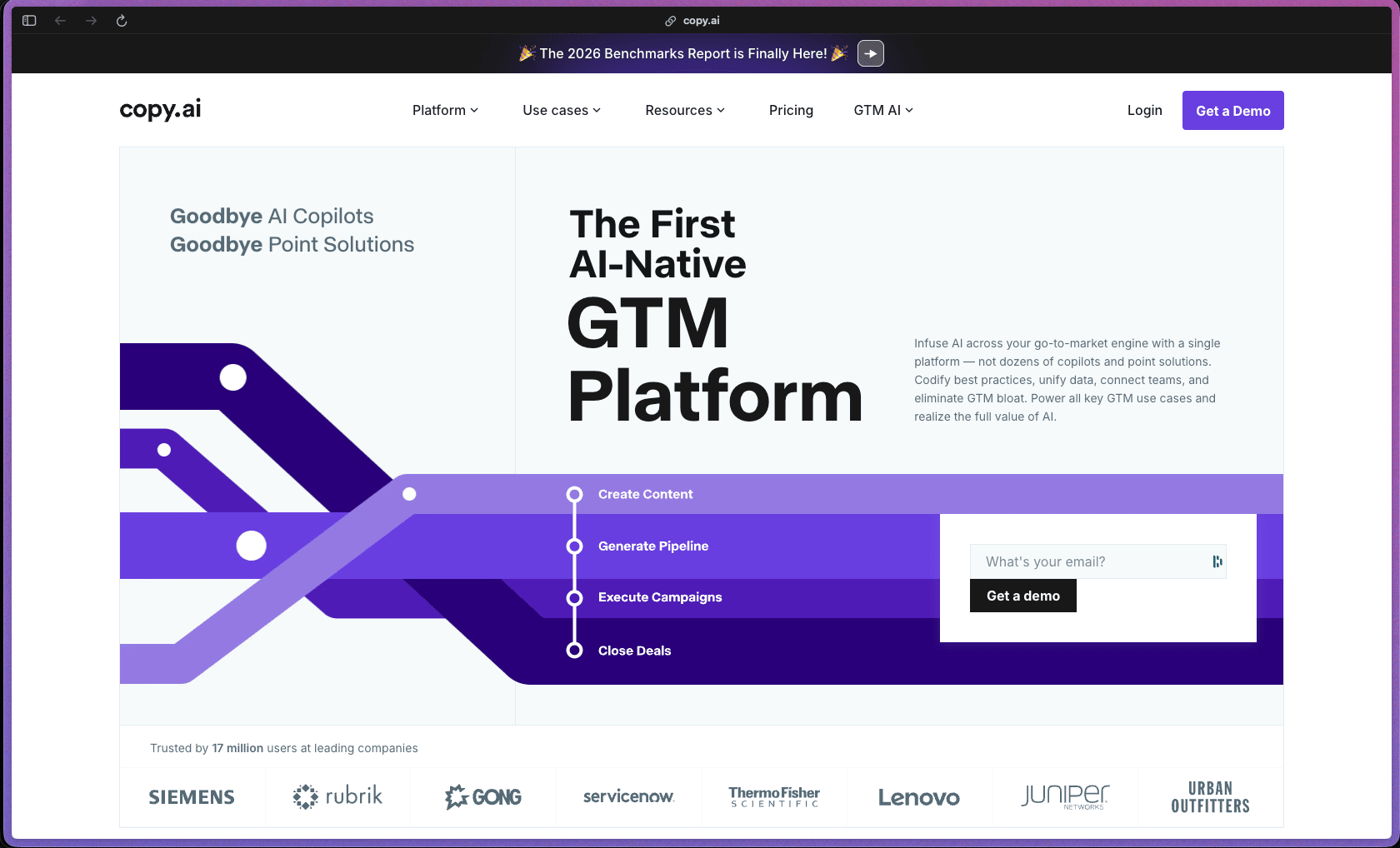
Copy.ai has evolved from a single-output AI copywriting tool into a broader GTM workflow platform—an unusual repositioning that makes it meaningfully different from copywriting-only tools if your team uses it for sales automation (prospecting, enrichment, outreach) alongside content generation. Its Infobase feature stores brand voice, product data, and company context so every output pulls from your actual information rather than generic AI knowledge—a practical improvement over tools that require re-entering context every time. With 15 million+ reported users and a G2 rating of 4.9/5, it has a substantial and active user base that reflects real adoption at scale rather than early-stage momentum.
Copy.ai uses a freemium subscription model—a free plan is available with limited credits and access, while paid plans (Starter, Advanced, and Enterprise) are billed monthly or annually and scale by the number of seats and workflow run credits. Enterprise plans include custom pricing with dedicated onboarding, data handling agreements, and expanded workflow run limits.
Copy.ai offers a free plan with no credit card required, allowing users to test the platform and generate content before committing to a paid subscription. Refund policy for paid subscriptions is not prominently specified on the official pricing page—buyers should review Copy.ai's terms of service or contact support directly to confirm cancellation and billing terms before upgrading.
Copy.ai is "mature/established" within the AI writing tools category—launched in 2020, it was among the first widely adopted AI copywriting tools and has maintained one of the largest reported user bases in the space with 15 million+ reported users. The platform has undergone a significant strategic evolution, shifting from a copywriting templates tool to a self-described "GTM AI platform" with automated multi-step Workflows, Infobase (brand knowledge storage), and sales use cases including prospecting and outreach—indicating active investment in expanding its product scope beyond its original positioning. The combination of substantial venture funding, a large user base, and ongoing platform-level repositioning suggests the product is actively developing rather than in maintenance mode, though the strategic pivot means the feature set today is quite different from what early adopters signed up for.
- Rated 4.9 out of 5 on G2 based on Copy.ai's own review page, with an Ease of Use score of 9.6/10 and Quality of Support score of 9.6/10 from verified G2 reviewers.
- Rated 4.4 out of 5 on Capterra from 67 verified reviews, with a 60% likelihood-to-recommend score; reviewers highlight strong first-draft quality and template variety alongside some concerns about tone consistency.
- Copy.ai reports 15 million+ users across its customer base, making it one of the highest reported user counts in the AI writing tools category.
- Trustpilot shows a notably lower 1.9/5 average from 195 reviews, which contrasts sharply with G2 and Capterra scores—buyers should review both positive and critical feedback across platforms before purchasing.
- Copy.ai raised $11 million in early funding from Sequoia and Tiger Global, and its pitch deck featured a "Wall of Love" style customer testimonial slide as primary social proof—indicating the product had earned organic positive sentiment early in its growth.
- A free-text Chat interface lets you submit open-ended prompts to generate any type of content—blog sections, email drafts, social posts, ad copy, or product descriptions—without being locked into template inputs.
- 90+ pre-built content templates cover common marketing and sales formats—Facebook and Google ads, email subject lines, product descriptions, landing page copy, sales emails, LinkedIn posts, video scripts, press releases, and more—providing structured starting points for each content type without starting from a blank page.
- Long-form blog post and article drafting lets you build extended written content from a brief outline or topic input, with the ability to guide structure and tone across multiple sections in one session.
- Multi-language content generation supports producing output in multiple languages, making the platform usable for teams targeting international markets without separate localized writing tools.
- Sales copy frameworks (AIDA, PAS, and others) are available as template types, allowing marketers to generate persuasive copy in a specific structural format suited to different campaign types.
- A product description generator takes a product name and brief inputs and produces formatted e-commerce or marketing copy in various tone and length configurations.
- Cold email and LinkedIn outreach generation creates personalized prospecting messages from prospect data inputs, useful for sales teams running high-volume outreach who need to personalize at a per-message level without writing each one manually.
- API access is available on paid plans, allowing Copy.ai to be embedded into custom internal tools, CRMs, or content pipelines—useful for engineering teams building proprietary workflows on top of Copy.ai's generation capabilities.
- The platform supports connecting to OpenAI, Anthropic (Claude), and Google Gemini models, giving users the ability to choose which underlying AI model runs their workflows rather than being limited to a single provider.
- Native integrations with CRM and sales tools (including HubSpot and Salesforce at Enterprise tier) allow prospect data to flow into outreach and content workflows directly, reducing manual data entry between systems.
- Zapier-compatible integrations extend connection options to hundreds of third-party tools not covered by native integrations, allowing Copy.ai workflow outputs to trigger actions in downstream apps.
- The Workflows builder lets you create multi-step automated content pipelines that chain actions together—such as pulling prospect data, enriching it, writing a personalized email, and logging the output to a spreadsheet—running from a single trigger or bulk input.
- Bulk workflow runs allow processing a list of inputs (e.g., 50 prospects, 100 product names, 20 blog topics) in one batch, generating individualized outputs for each row without submitting each item as a separate prompt.
- Account-based marketing (ABM) workflows automate the creation of personalized campaign assets per target account, pulling account-level research data and transforming it into tailored messaging at scale without per-account manual work.
- Inbound lead processing workflows can be configured to automatically qualify, score, and generate follow-up content for leads as they enter the system, reducing the manual processing time between lead capture and first outreach.
- Workflow run history and output logs keep a record of past automation runs so teams can review, reference, and reuse previously generated outputs without regenerating from scratch.
- Usage tracking across the account shows credit consumption against plan limits, allowing teams to monitor how quickly they're using their monthly workflow and word generation allowance before hitting a cap.
- G2 reviewers confirm the platform includes performance dashboard elements for reviewing content and workflow outputs, though detailed analytics and campaign-level performance reporting are not prominently featured in the public product documentation—teams requiring deep content analytics should verify current reporting capabilities before purchase.
- Infobase is a centralized knowledge store where you upload brand voice guidelines, product descriptions, company details, and target audience information; when writing prompts, you reference this stored data with a # tag so every output reflects your actual brand context rather than generic AI defaults.
- Tone selection lets you specify the writing style for outputs—professional, conversational, persuasive, witty, or custom—so generated content stays consistent with your brand voice across different content types and team members.
- Custom workflow templates can be saved and shared across team members, allowing a marketing operations lead to build a workflow once and make it reusable by the entire team without everyone needing to know how to configure it.
- The platform supports selection between multiple underlying AI models (OpenAI, Anthropic Claude, Google Gemini) per workflow or task, allowing teams to choose the model that performs best for a specific content type.
- Infobase stores brand and company data within Copy.ai's system in a way that is explicitly described as not publicly shared—your uploaded company context, pricing data, and product information are used only within your own account's generation requests.
- Enterprise plans include custom data handling terms and security agreements, making it suitable for larger organizations with specific compliance or data governance requirements.
- Specific security certifications (SOC 2, GDPR compliance documentation) are not prominently listed on the public-facing pricing or features pages—buyers with strict compliance requirements should request Copy.ai's security documentation directly before purchasing Enterprise tier.
- B2B marketing teams at SaaS or services companies who need to produce personalized account-based marketing content at scale—targeting dozens or hundreds of named accounts with tailored messaging without a proportionally large content team.
- Sales development representatives (SDRs) and outbound sales teams who run high-volume prospecting and need personalized cold emails and LinkedIn messages generated from prospect data inputs in bulk, rather than writing each one from scratch.
- Content marketing teams and agencies managing multiple clients who need first-draft blog posts, social media content, and ad copy generated quickly to feed an editorial or delivery pipeline, reducing per-piece writing time.
- E-commerce teams managing large product catalogs who need to generate and regularly refresh product descriptions across hundreds of SKUs using a structured bulk workflow rather than individual manual writes.
- Marketing operations leads who want to build standardized AI content workflows—templated, repeatable, and shareable across a team—so junior or non-technical team members can run complex content processes without configuring AI prompts each time.
- Use it for personalized cold outreach at scale when you have a prospect list and need individualized emails or LinkedIn messages for each contact generated from their job title, company, and industry data in a single batch workflow run.
- Use it for generating first-draft blog posts and long-form articles when your content team is producing high volumes of SEO or editorial content and needs to reduce per-post writing time from hours to a review-and-edit workflow.
- Use it for building ABM campaign assets when you're targeting a defined set of named accounts and need personalized case study angles, landing page copy, and email sequences tailored to each account's industry and strategic priorities.
- Use it for bulk product description creation when you have an e-commerce catalog update or new product launch with dozens of SKUs that all need original, on-brand descriptions generated simultaneously from a structured data input.
- Use it for ad copy A/B test variants when you need multiple headline and body copy variations for Facebook, Google, or LinkedIn ads generated quickly for split testing without bribing a copywriter for each iteration.
- Use it for content repurposing workflows when you want to automatically transform a long-form asset—a sales call recording, webinar transcript, or blog post—into a set of social posts, email snippets, and short-form content without manually rewriting each format.
- Cloud-hosted SaaS platform accessible via web browser at copy.ai—no installation required; works on any modern browser on Mac, Windows, or Linux.
- No native desktop or mobile app is listed on the official site; the platform is web-browser based, though it is accessible via mobile browser.
- Supports three underlying AI model providers—OpenAI, Anthropic (Claude), and Google Gemini—with model selection available per task or workflow on paid plans.
- API access available on paid and Enterprise plans for custom integrations and embedding Copy.ai capabilities into internal tools or CRM pipelines.
- Zapier integration and native CRM connections (HubSpot, Salesforce on Enterprise) allow workflow outputs to be sent downstream to existing sales and marketing systems.
Copy.ai started as a direct competitor to Jasper and Writesonic in the AI copywriting templates space, but has since repositioned as a "GTM AI platform" focused on sales and marketing workflow automation—making it more comparable to tools like Workflow86, Clay (for prospecting), or custom n8n pipelines than to pure AI writing tools for content creators. This positioning shift means it works well for B2B revenue teams that need both content generation and sales automation in one platform, but may feel over-engineered for solo bloggers or individual creators who just need help writing articles and social posts. The Infobase feature—centralizing brand context so every team member's output is grounded in the same company data—is the most concrete differentiator from generic AI writing tools that start from a blank context with every prompt.
- Support is available via the in-app help system and email; G2 and Copy.ai's own review page both report a Quality of Support score of 9.6/10, suggesting strong satisfaction among users who have needed assistance.
- Documentation is maintained in a dedicated help center and blog covering workflow configuration, Infobase setup, template usage, API integration, and platform-specific use cases for sales and marketing teams; the Copy.ai blog is also actively published with GTM-specific content marketing guides.
- The platform has an active presence on LinkedIn and YouTube with tutorial content and workflow demonstration videos; there is no prominently advertised dedicated community forum, Discord, or user group available for peer support.
- Trustpilot shows a 1.9/5 average from 195 reviews—significantly lower than the G2 and Capterra scores—with themes around customer service quality, billing issues, and unmet expectations after the platform's strategic repositioning away from simple copywriting templates; buyers should read a cross-section of reviews across platforms before purchasing.
- The platform's pivot toward a GTM workflow platform means the free plan and lower-tier subscriptions have become more restrictive in workflow run credits, making the tool less accessible for light users who want occasional content generation without a full automation platform commitment.
- No native mobile app is available—all functionality requires browser access, which limits on-the-go usage for teams that work frequently from mobile devices.
- Detailed analytics and campaign performance reporting for content and workflows are not prominently featured in the public product documentation—teams that need granular output tracking and performance measurement alongside generation should verify current reporting depth before purchasing.
Related Products
Recently Added!
LinkBoss
Recently Added!
Frase
Recently Added!
ContentBot
Products With Lifetime Deals
Recently Added!
FluentForms
Recently Added!
Divi Theme
Recently Added!
ConvertPro
Recently Added!
CartFlows
Recently Added!
Bullet Proof Security
Recently Added!
WP Booking Calendar
Recently Added!
BeaverBuilder
Recently Added!
Avada
Recently Added!
Independent Analytics
You Recently Viewed These
Recently Viewed
BitFlows

Recently Viewed
Amelia
Recently Viewed
Dynamic.ooo

Recently Viewed
Microthemer & Amender

Recently Viewed
LifterLMS

Recently Viewed
Masteriyo

Recently Viewed
Zynith SEO
Recently Viewed
Wrike
Recently Viewed
WPMU Dev
Recently Viewed
wpDataTables
Recently Viewed
WP Booking Calendar
Recently Viewed
Webflow