
DigitalOcean
DigitalOcean
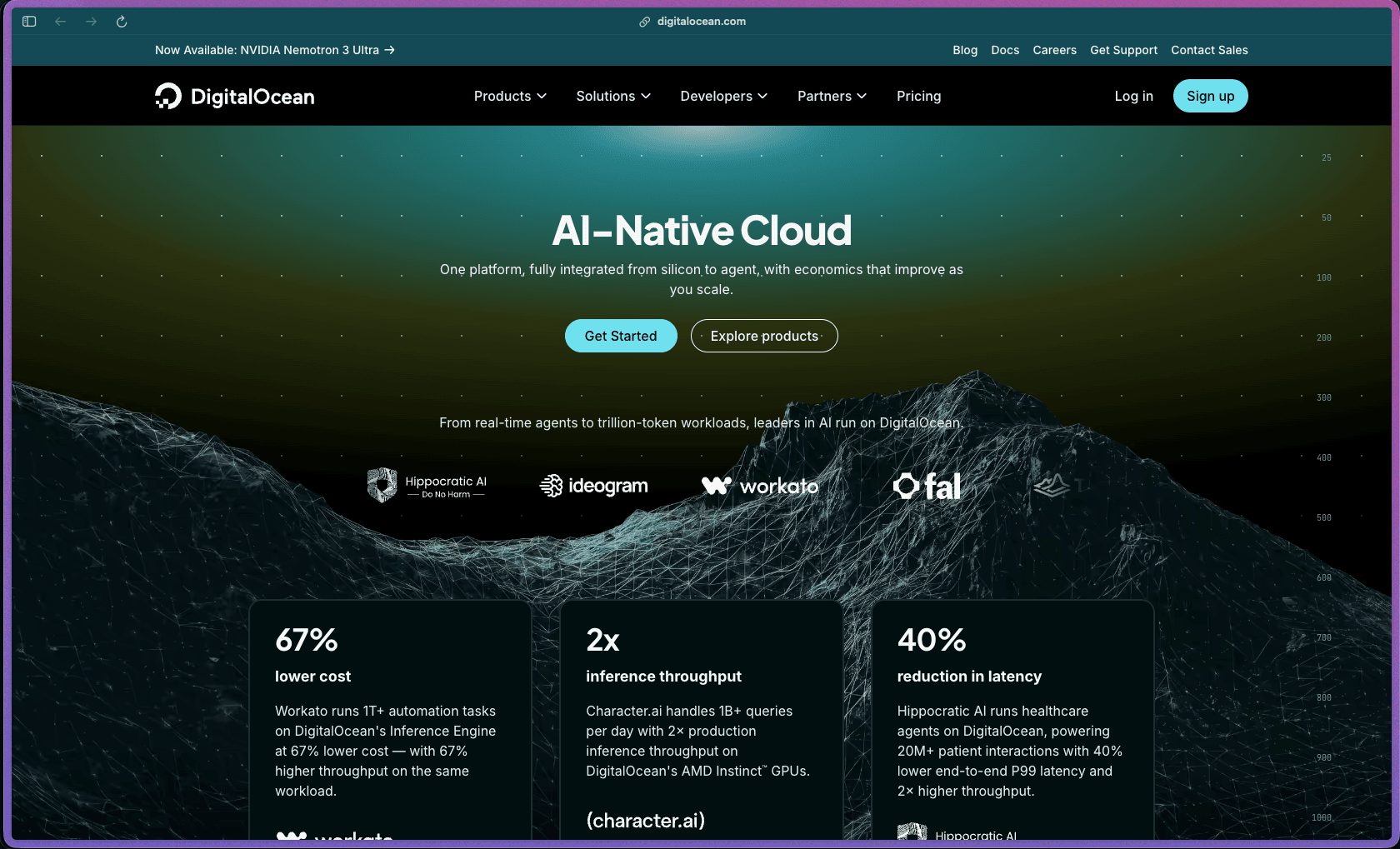
DigitalOcean's consistent positioning as the developer-friendly, straightforward cloud—no opaque pricing, no 300+ fragmented services to navigate—makes it a practical starting point for founders and small engineering teams who need real cloud infrastructure without learning AWS's organizational complexity. It has expanded well beyond its original VM-only offering to include managed Kubernetes, managed databases, object storage, serverless functions, a PaaS (App Platform), and now an integrated AI inference stack with GPU support—meaning it can serve teams from their first Droplet to a meaningful production scale. With 650,000+ users, 20 data centers across 11 regions, and a publicly traded company (NYSE: DOCN) reporting $170M Q1 2026 revenue, it has the infrastructure and commercial stability that early-stage startups need in a cloud provider.
DigitalOcean uses strictly pay-as-you-go, usage-based pricing—you are billed for what you actually consume, with no base platform fee, no annual commitment required, and no hidden tier gates. As of January 2026, Droplet (VM) billing moved to per-second granularity (with a 60-second minimum charge), reducing costs for short-lived workloads like batch jobs and automated testing.
New customers who have never previously been paying DigitalOcean users can access a $100 credit, 60-day free trial—a credit card is required for identity verification but is not charged during the trial period; any usage above $100 or after 60 days is billed at standard rates. No money-back guarantee policy is prominently described on the official site beyond the free trial; refund policy is not specified for paid usage beyond the trial period—buyers should review DigitalOcean's terms of service for billing dispute procedures.
DigitalOcean is "mature/established"—founded in 2012 and publicly listed on the NYSE (ticker: DOCN) since 2021, it has been in continuous operation for over 13 years and has grown from a single VM product to a multi-service cloud platform serving hundreds of thousands of paying customers at significant revenue scale. The platform has maintained active product development throughout its history—introducing managed Kubernetes (DOKS), App Platform (PaaS), managed databases, serverless functions (Functions), and most recently a fully integrated AI inference stack with GPU infrastructure and an Inference Router—indicating a well-resourced product organization rather than a static infrastructure provider. Documentation is updated to June 2026 and comprehensive across all product areas, and the DigitalOcean Community—one of the most well-regarded developer Q&A communities in the cloud infrastructure space—has accumulated a substantial library of tutorials and answers over more than a decade.
- Rated 4.6 out of 5 on G2 from 1,920 verified reviews across 15 product categories, holding a #1 ranking in 9 G2 categories—one of the strongest review profiles in the cloud infrastructure segment.
- 650,000+ users across 20 data centers in 11 regions trust the platform for production infrastructure, as reported in DigitalOcean's Q1 2026 investor materials.
- Q1 2026 revenue reached $170 million (22% year-over-year growth), indicating sustained commercial momentum and platform investment—not a stagnant or declining product.
- AI customer Annual Recurring Revenue grew 221% year-over-year to $183M in Q1 2026, reflecting significant traction in the AI infrastructure use case—a meaningful signal of platform evolution beyond its original developer VM positioning.
- G2 reviewers consistently highlight transparent pricing, fast Droplet provisioning, clean UI, and solid documentation as primary strengths—alongside recurring candid notes that enterprise-level networking features and advanced IAM capabilities are less developed than AWS or GCP.
- Droplets (virtual machines) are Linux-based cloud VMs available in several configurations—Shared CPU (for low-traffic sites, blogs, and microservices), General Purpose (for mid-to-high traffic apps), CPU-Optimized (for media streaming, analytics, and ML), Memory Optimized (for high-performance databases and caches), Storage Optimized (for large NoSQL databases and monitoring tools), and GPU-powered—each spinning up in seconds from the control panel or API.
- App Platform is a PaaS layer built on Kubernetes that deploys applications directly from a GitHub, GitLab, or Bitbucket repository with minimal configuration—handling the underlying container orchestration, scaling, SSL, and networking automatically so teams don't need to manage infrastructure separately from their code.
- Managed Kubernetes (DOKS) provides a fully managed Kubernetes service where DigitalOcean handles control plane operations, upgrades, and availability—giving teams the scalability of Kubernetes without needing to manage the cluster infrastructure directly.
- Managed Databases covers PostgreSQL, MySQL, Redis, and MongoDB as fully managed services with automated backups, updates, failover, and high availability built in—removing the manual operational work of running a production database on a self-managed VM.
- Spaces Object Storage provides scalable S3-compatible object storage for storing and serving large amounts of unstructured data (images, video, backups, static assets) with a built-in CDN option for global content delivery.
- Block Storage Volumes are attachable SSD volumes that extend Droplet disk capacity independently from the VM itself—useful when your application's storage needs outgrow the Droplet's root disk without requiring a larger (and more expensive) Droplet tier.
- Load Balancers distribute incoming traffic across multiple Droplets, keeping applications available and performing consistently during traffic spikes without exposing individual server IPs.
- Serverless Functions let you run event-triggered code without provisioning or managing servers—suitable for automating lightweight tasks, webhooks, and background processes that don't justify a full VM or container setup.
- An AI Inference stack—including GPU-backed Droplets, an Inference Router, and an OpenAI-compatible API endpoint—covers running open-weight models (DeepSeek, Llama, Qwen) and frontier model inference at production scale, with the Inference Router automatically selecting the optimal model per call without requiring code changes when a better model ships.
- DNS management and domain registration are available within the platform, allowing teams to manage domain records, nameservers, and DNS configurations alongside their infrastructure in one control panel.
- VPC (Virtual Private Cloud) networking allows Droplets, databases, and Kubernetes nodes within a team's account to communicate over a private network that is not exposed to the public internet—a meaningful security feature that G2 reviewers specifically call out as a differentiator from cheaper VPS providers.
- One-click application deployments (called Marketplace Apps) allow commonly used software stacks—WordPress, LAMP, LEMP, Docker, Ghost, Discourse, Nextcloud, and others—to be installed on a fresh Droplet without manually configuring the server from scratch.
- A comprehensive REST API with official client libraries in Python (pydo), Ruby (DropletKit), Go, and JavaScript allows full programmatic control of all DigitalOcean resources—provisioning, scaling, networking, monitoring, and billing—from any application or CI/CD pipeline.
- The doctl CLI tool provides command-line access to all DigitalOcean platform operations, allowing developers and DevOps teams to manage infrastructure from terminal workflows and shell scripts without using the web control panel.
- Terraform and Pulumi providers are available for managing DigitalOcean infrastructure as code—letting teams define, version, and reproduce cloud environments using the same infrastructure-as-code workflows they use with other cloud providers.
- GitHub and GitLab repository integration is built into App Platform, allowing automatic deployments triggered by code pushes to defined branches—supporting standard CI/CD patterns without needing to configure a separate pipeline just to connect the repository to the cloud.
- The DigitalOcean Marketplace lists 100+ one-click apps and partner solutions (databases, CMS platforms, security tools, monitoring agents, and developer frameworks) deployable directly from the control panel.
- Container Registry allows teams to store and manage private Docker images within DigitalOcean, accessible by their Kubernetes clusters and Droplets without configuring an external container registry service.
- Per-second billing on Droplets (effective January 2026, with a 60-second minimum) means short-lived automated workloads—batch jobs, test environments, scheduled scripts—accrue only their actual consumed compute cost rather than a full hourly or daily charge.
- Automated backups can be scheduled for Droplets on a weekly basis (or more frequently through Snapshots), and managed databases perform automated daily backups with configurable retention—reducing manual backup operation overhead.
- Kubernetes autoscaling in DOKS allows node pools to scale up or down automatically based on workload demand, preventing both over-provisioning during quiet periods and under-provisioning during traffic spikes without manual intervention.
- App Platform handles automatic horizontal scaling, SSL certificate provisioning and renewal, and container restarts after failures—removing the need to manually manage these operational tasks on every deployment.
- Built-in infrastructure monitoring collects system-level metrics (CPU, memory, disk I/O, bandwidth) using an open-source agent on Droplets, with dashboards, configurable alert policies, and notification delivery via email or Slack—available at no additional cost on all plans.
- A billing dashboard and cost calculator provide transparent real-time and projected spend visibility across all active resources, allowing teams to monitor cloud costs without unexpected end-of-month billing surprises.
- Droplet and Kubernetes usage metrics are available via the control panel and API, allowing teams to integrate DigitalOcean monitoring data into their own observability stacks (Datadog, Grafana, Prometheus) through compatible scrape endpoints and integrations.
- Teams and role-based access control (RBAC) allow DigitalOcean accounts to add multiple collaborators with defined permission levels—controlling who can create, modify, or delete resources without sharing root account credentials.
- Custom Droplet Images allow teams to create and store snapshots of pre-configured Droplets, enabling fast duplication of standardized environments (production-like staging, specific OS configurations, pre-installed software stacks) without repeating manual setup.
- VPC configuration allows custom private network topology across Droplets, databases, and Kubernetes clusters within a region—isolating services from each other and from public internet exposure at the network layer.
- VPC private networking ensures that database connections, inter-service traffic, and Kubernetes node communication can stay off the public internet entirely, reducing attack surface without requiring additional network security tooling.
- Free SSL certificates are automatically managed for App Platform deployments and Spaces CDN endpoints, removing the need to source, install, and renew certificates manually.
- Two-factor authentication (2FA) and SSH key management are available for all accounts, providing standard access security controls for team members and automated deployment systems.
- SOC 2 Type II compliance and ISO/IEC 27001 certification are maintained by DigitalOcean; compliance documentation is available for enterprise customers under NDA or upon request—buyers with formal compliance requirements should contact DigitalOcean's sales team for documentation.
- Solo developers and indie founders launching web applications, APIs, or SaaS products who want a production-grade cloud environment without navigating the complexity and cost structure of AWS or Azure.
- Early-stage startups (seed to Series A) running containerized applications on Kubernetes who need managed cluster infrastructure at a cost-effective price point before scaling justifies a move to larger cloud providers.
- Small engineering teams (2–15 developers) at bootstrapped or lightly funded software companies who need a predictable, transparent monthly cloud bill with no surprise charges tied to complex pricing models.
- AI and ML developers who need GPU-backed inference infrastructure and access to open-weight models (Llama, DeepSeek, Qwen) without building a multi-provider inference pipeline from scratch.
- Agencies and freelancers hosting multiple client web applications who want a reliable, simple control panel for managing VMs, databases, and domains across projects without enterprise cloud overhead.
- Development teams deploying from GitHub or GitLab repositories who want App Platform's automatic deployment pipeline—no CI/CD configuration overhead—to serve web apps and static sites without managing servers.
- Use it for hosting a web application or API when you need a reliable, configurable cloud VM or managed container environment and want to avoid the pricing complexity of AWS EC2 or Azure App Service for a straightforward production deployment.
- Use it for running managed PostgreSQL or MySQL in production when your team needs a reliable database with automated backups, updates, and high availability handled for you, without the operational overhead of self-managing a database server on a VM.
- Use it for deploying containerized applications on Kubernetes when your team uses Docker and wants a managed Kubernetes service that handles control plane operations and cluster upgrades without requiring dedicated DevOps headcount.
- Use it for storing and serving large media or backup files at scale when your application generates significant unstructured data (images, videos, exports, logs) that needs durable, CDN-backed object storage without per-request pricing surprises.
- Use it for running AI model inference in production when your application needs low-latency, GPU-backed inference on open-weight models with a single OpenAI-compatible API endpoint—without managing model serving infrastructure yourself.
- Use it for spinning up short-lived test or staging environments when your team needs clean, reproducible infrastructure for CI/CD pipelines, pre-launch testing, or client demos—and wants per-second billing so idle test environments don't accumulate unnecessary costs.
- Cloud-hosted infrastructure platform (IaaS + PaaS); all resources are managed via a web control panel at cloud.digitalocean.com, the doctl CLI, or the REST API—no software installation required on the user's side.
- Compatible with any Linux-based workload; Droplets support Ubuntu, Debian, Fedora, CentOS, Rocky Linux, and Arch Linux as base operating systems, with additional custom image support.
- App Platform (PaaS) supports Node.js, Python, Go, PHP, Ruby, and static site deployments directly from GitHub, GitLab, or Bitbucket repositories.
- Terraform, Pulumi, Ansible, and standard Kubernetes tooling (kubectl, Helm) are all compatible with DigitalOcean's infrastructure and Kubernetes service for infrastructure-as-code and GitOps workflows.
- Spaces Object Storage is S3-compatible, meaning any tool or SDK that works with Amazon S3—including the AWS CLI, s3cmd, and popular S3 libraries in Python, Node, and Ruby—works with DigitalOcean Spaces without code changes.
- 20 data center locations across 11 global regions (as of Q1 2026) allow deployments in North America, Europe, Asia-Pacific, and beyond for latency-sensitive or data-residency-sensitive applications.
DigitalOcean occupies a distinct position in the cloud infrastructure market—above shared hosting and cheap VPS providers (Hostinger, Vultr, Linode/Akamai) in terms of managed service depth and reliability, and below AWS, Azure, and GCP in feature breadth and enterprise complexity. This positioning is intentional: DigitalOcean has consistently prioritized simplicity, documentation quality, and transparent pricing over feature parity with hyperscale clouds—making it a stronger fit for startups and individual developers who want professional-grade infrastructure without needing a dedicated cloud architect to manage it. G2 reviewers who have used both consistently note that DigitalOcean's networking features (particularly advanced routing, VPN, and IAM) are less configurable than AWS or GCP—something worth considering before choosing it for large enterprise workloads, but generally not a constraint for the startup and SMB use cases it's built for.
- All DigitalOcean customers receive free ticket-based (email) support with no paid support plan required; paid support plans (Basic, Business, Premier) are available for faster response times, live chat access, designated technical account managers, and a guaranteed SLA response window—support plan pricing is not prominently listed publicly and should be requested from DigitalOcean sales for Enterprise or Premier tiers.
- DigitalOcean's official documentation at docs.digitalocean.com is among the most comprehensive and consistently praised in the cloud infrastructure category—G2 reviewers specifically call out the documentation quality as a standout—covering every product with step-by-step tutorials, API references, quickstart guides, and configuration examples that are kept actively updated.
- The DigitalOcean Community (community.digitalocean.com) hosts a large library of developer tutorials, Q&A threads, and open-source project guides; it has been active for over a decade and is regularly cited by developers as one of the most useful self-service resources in the developer cloud space—supplementing official documentation with real-world configuration examples and peer answers.
- Enterprise-grade networking features—advanced routing, BGP peering, sophisticated VPN configurations, and complex multi-region network topologies—are less developed than those offered by AWS, Azure, or GCP; teams with complex networking requirements should verify current capability before choosing DigitalOcean over a hyperscale provider.
- IAM (Identity and Access Management) granularity is more limited than AWS IAM or GCP IAM—G2 reviewers specifically note that role and permission management capabilities still lack the depth expected for larger team and enterprise governance use cases.
- Droplets (VMs) are still billed even when in a powered-off state (you pay for the reserved resources, not just active compute)—a point of friction for teams who expect to pay zero for stopped VMs, as opposed to the per-second active-compute billing model some other providers use.
- No native Windows Server Droplet options are listed—DigitalOcean is a Linux-based cloud platform; teams with Windows Server workload requirements need to look elsewhere or run Windows in a custom image, which is an advanced and unsupported configuration.
Related Products
Recently Added!
Webflow
Recently Added!
Sniply

Recently Added!
Nero

Recently Added!
miniOrange

Format

Base44

Recently Added!
AI ML API
Products With Lifetime Deals
Recently Added!
FluentForms
Recently Added!
Divi Theme
Recently Added!
ConvertPro
Recently Added!
CartFlows
Recently Added!
Bullet Proof Security
Recently Added!
WP Booking Calendar
Recently Added!
BeaverBuilder
Recently Added!
Avada
Recently Added!
Independent Analytics
You Recently Viewed These
Recently Viewed
BitFlows

Recently Viewed
Amelia
Recently Viewed
Dynamic.ooo

Recently Viewed
Microthemer & Amender

Recently Viewed
LifterLMS

Recently Viewed
Masteriyo

Recently Viewed
Zynith SEO
Recently Viewed
Wrike
Recently Viewed
WPMU Dev
Recently Viewed
wpDataTables
Recently Viewed
WP Booking Calendar
Recently Viewed
Webflow