Zynith SEO
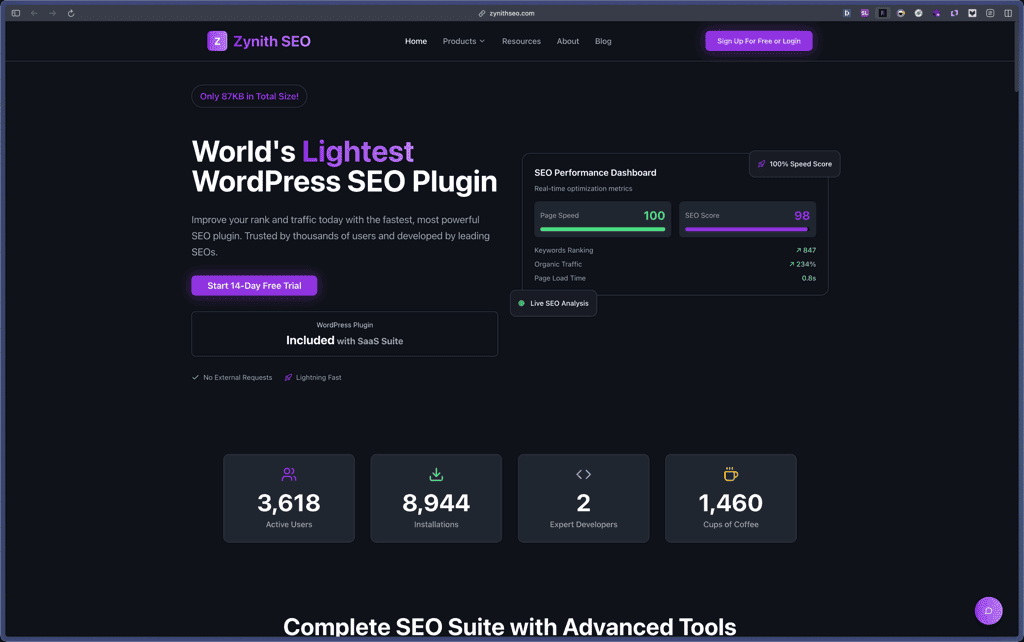
Zynith SEO focuses on being extremely lightweight while still giving advanced control over meta tags, XML sitemaps, schema, and technical SEO settings. This works well for WordPress builders and agencies who care about performance scores but s
Zynith SEO is sold as a paid WordPress plugin with subscription-style plans (monthly and yearly) rather than a one-time license. A broader Zynith SEO platform account for online tools also appears to run as a SaaS subscription. Not all plan details are specified on public pages.
Public product and pricing pages do not clearly state a standard refund window, money-back guarantee, or free trial conditions for the WordPress plugin or SaaS platform. Refund policy not specified on the official site.
Zynith SEO’s WordPress plugin has been available since at least mid‑2023, with changelog and external listings showing ongoing version updates into 2025. Documentation, a getting-started guide, and community channels suggest a growing/stable product rather than an early prototype.
- The main site highlights that its WordPress SEO plugin is trusted by “thousands of users” and developed and reviewed by experienced SEOs.
- Third-party marketplaces and reviews describe it as a popular lightweight WordPress SEO plugin focused on performance and advanced schema.
- A public LinkedIn company page exists for Zynith SEO, indicating an active brand presence.
- Provides on-page SEO controls for title tags, meta descriptions, Open Graph data, and target keywords so you can tune how each page appears in search and on social.
- Generates and manages optimized XML sitemaps to help search engines discover and index your pages more efficiently.
- Includes built-in schema and JSON-LD tools so you can add rich snippets for content types like articles, products, FAQs, and organizations.
- Offers content and SEO signal analysis that surfaces keyword usage, structure, and other on-page signals to guide improvements.
- Designed to work smoothly with major WordPress page builders such as Oxygen, Bricks, Elementor, and WPBakery, which helps agencies integrate SEO into existing build workflows.
- Supports breadcrumb markup, social previews (Open Graph and Twitter Cards), and local/commerce-focused schema to align SEO with other plugins like WooCommerce. Exact integration list is not fully detailed.
- Automatically builds and updates XML sitemaps so you do not need a separate sitemap plugin or manual updates.
- Can monitor 404 errors and manage redirects, helping you clean up broken links and maintain SEO equity with less manual checking.
- Handles automatic image SEO (such as alt and file-related optimizations) to improve search friendliness of media with minimal extra work. Implementation details are high level in public info.
- Provides SEO performance signals and scoring to show how well content is optimized, including insights into keyword density and readability.
- Supports viewing important SEO signals directly in the WordPress interface so you can see potential issues while editing content.
- Lets you fine-tune global SEO behavior, including robots meta settings, canonical URLs, RSS and category base options, and sitemap inclusion, giving granular control over what search engines see.
- Includes a script/code manager and custom CSS options for elements like table of contents and breadcrumbs, helping you match SEO elements to your site design.
- Supports import/export of SEO data and a purge option so you can move settings between sites or cleanly remove its data if needed.
- Emphasizes “no external requests” and no outbound data collection from the WordPress site, which helps keep performance tight and reduces reliance on third-party calls.
- Allows control over robots.txt and indexing directives (noindex/nofollow) to manage how bots access content; standard security certifications are not detailed.
- WordPress agencies that need advanced SEO controls but want to keep client sites fast and lightweight.
- Technical SEOs and consultants who prefer manual control over schema, indexing, and meta data instead of heavily automated “black box” settings.
- Bloggers and content-heavy sites that want better meta control, table of contents, and internal SEO insights without bloating their stack.
- E‑commerce and WooCommerce store owners who want SEO improvements, structured data, and speed-conscious optimization on WordPress.
- Developers and builders working with Oxygen, Bricks, Elementor, or similar tools who want an SEO plugin that plays nicely with their chosen stack.
- Use it for on-page SEO tuning when you need precise control over titles, descriptions, and social previews for each post or product page.
- Use it for technical SEO cleanup when you want to manage robots rules, canonicals, category bases, and WordPress head output from one place.
- Use it for structured data setup when you want to add or refine JSON-LD schemas for rich results without relying on separate schema plugins.
- Use it for performance-conscious SEO when existing plugins feel heavy and you want to protect Core Web Vitals and page speed while still handling SEO basics.
- Use it for monitoring issues like 404s and redirects so you can catch broken links and keep users and search engines on the right paths.
- WordPress plugin that installs directly into your WordPress site and manages SEO from within wp-admin.
- Built to be extremely small in file size (tens of kilobytes) compared with larger SEO plugins, helping reduce overhead on page loads.
- Works alongside modern WordPress builders and common plugins (including WooCommerce), with no external calls required for core SEO functionality.
- Connected to a broader Zynith SEO web platform where users can log in for additional SEO tools and resources, accessed via browser.
Zynith SEO positions itself as a performance-first alternative to heavyweight WordPress SEO plugins, focusing on being extremely lightweight while still offering advanced controls like schema builders and technical settings. Compared with more automated “all-in-one” SEO suites, it leans toward giving power users and agencies granular, manual control without bundling marketing dashboards or bloated extras into the WordPress admin.
- Provides a “Getting Started” guide and learning resources to walk users through setup and key plugin functions.
- Mentions a user community group (for example on Facebook) plus additional channels like GitHub and Discord for questions and feedback.
- Tutorial and introduction videos from the team and partners show real setups and explain features like schema, 404 monitor, and metadata editing.
- Focused on WordPress; it does not serve non‑WordPress sites directly as an SEO plugin.
- Some advanced claims (such as specific speed comparisons and “world’s lightest” positioning) are marketing statements and not independently verified in public benchmarks.
- Centralized analytics beyond on-page signals may rely on separate tools or platform features, as full reporting capabilities are not fully detailed on public pages.
Related Products
Crocoblock

Bricks Builder
BlogVault

Amelia
wpDataTables
WP SimplePay

Support Candy

Qi Theme

NitroPack

Products With Lifetime Deals
Support Candy
New!
Bit Integrations

Amelia
Bricks Builder
BitFlows

Crocoblock
You Recently Viewed These
Recently Viewed
Deel
Recently Viewed
Craft

Recently Viewed
Cello

Recently Viewed
Butter
Recently Viewed
Bricks Builder
Recently Viewed
Brevo
Recently Viewed
Umso - Website Builder
Recently Viewed
Amelia
Recently Viewed
Zynith SEO
Recently Viewed
Wrike
Recently Viewed
wpDataTables
Recently Viewed
Webflow